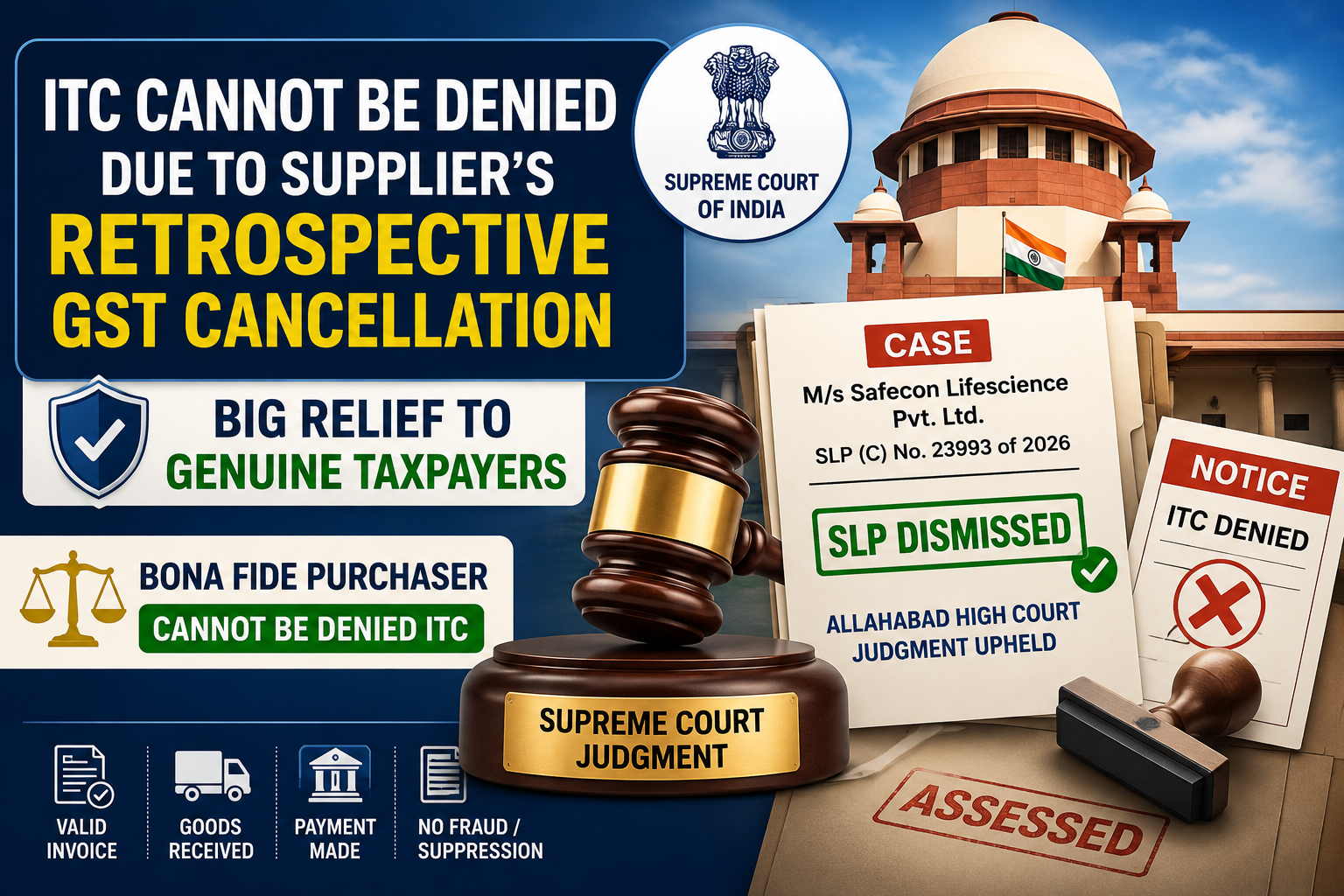
The Supreme Court has delivered a significant relief to genuine taxpayers by dismissing the Revenue’s Special Leave Petition (SLP) in Additional Commissioner Grade 2 & Anr. v. M/s Safecon Lifescience Private Limited [SLP (C) No. 23993 of 2026, Order dated 17 July 2026]. With this, the Supreme Court allowed the Allahabad High Court’s judgment to stand, reinforcing an important principle under GST law:
A bona fide purchaser cannot be denied Input Tax Credit (ITC) merely because the supplier’s GST registration was cancelled retrospectively, unless fraud, wilful misstatement, or suppression of facts is established against the recipient.
This ruling is expected to provide much-needed certainty to honest businesses that often face ITC disputes due to actions taken against their suppliers long after genuine transactions have been completed.
Background of the Case
M/s Safecon Lifescience Private Limited, engaged in the wholesale trading and manufacturing of pharmaceutical products, purchased medicines from a registered supplier during April 2021.
At the time of purchase:
- The supplier was a valid GST registered person.
- Tax invoices were issued.
- E-way bills and transport documents were available.
- Goods were actually received.
- Payments were made through banking channels.
- GST returns were duly filed by the supplier.
Subsequently, the GST Department received intelligence inputs alleging irregularities in the supplier’s affairs and initiated proceedings under Section 74 of the UPGST Act against Safecon Lifescience. The Department denied ITC primarily because the supplier’s registration had later been cancelled and alleged irregularities existed in the supplier’s upstream purchases.
Issue Before the Court
The central question was:
Can a genuine purchaser lose Input Tax Credit merely because the supplier’s GST registration is cancelled retrospectively or because the supplier allegedly committed irregularities, even though the purchaser has completed a genuine transaction?
Allahabad High Court’s Findings
The Allahabad High Court ruled in favour of the taxpayer and quashed the GST demand.
The Court observed that:
- The purchaser had produced all documentary evidence proving the genuineness of the transaction.
- The Department failed to disprove the movement of goods or banking transactions.
- There was no finding that the recipient had committed fraud, wilful misstatement or suppression of facts.
- Proceedings under Section 74 cannot be invoked merely on suspicion or unverified intelligence reports.
- Information received from other authorities should be independently verified before being relied upon against a taxpayer.
Supreme Court’s Decision
The Revenue challenged the Allahabad High Court’s judgment before the Supreme Court.
However, the Supreme Court refused to interfere and dismissed the Revenue’s SLP, observing that there was no good ground to entertain the petition.
Although the Supreme Court’s order is brief, it effectively leaves the Allahabad High Court’s judgment undisturbed, thereby strengthening the protection available to genuine purchasers under GST.
Important Legal Principle Emerging from the Judgment
The judgment reinforces an important principle:
A recipient cannot be denied Input Tax Credit merely because:
- the supplier’s GST registration was cancelled retrospectively;
- the supplier subsequently defaulted in tax compliance; or
- allegations are made against the supplier,
provided the recipient has acted bona fide and there is no evidence of fraud or collusion on its part.
Documents Every Taxpayer Should Preserve
This judgment also highlights the importance of maintaining proper documentation.
Businesses should preserve:
- Valid GST Tax Invoice
- E-Way Bill
- Transport documents / Lorry Receipt
- Proof of actual receipt of goods
- Bank payment proof
- Purchase records
- GST Returns
- Vendor due diligence records
Strong documentation significantly improves the chances of defending ITC during departmental scrutiny.
Practical Impact for Businesses
The decision provides comfort to businesses that have genuinely purchased goods from registered suppliers.
However, it should not be interpreted as blanket immunity.
If the Department establishes that:
- the transaction was bogus,
- invoices were fake,
- goods were never supplied,
- or the recipient actively participated in fraud,
the benefit of this judgment may not be available.
Key Takeaways
- A bona fide purchaser should not suffer for the subsequent default of the supplier.
- Retrospective cancellation of a supplier’s GST registration does not automatically result in denial of ITC.
- Proceedings under Section 74 require evidence of fraud, wilful misstatement, or suppression by the recipient.
- Proper documentation remains the strongest defence in GST litigation.
- The Supreme Court’s refusal to interfere provides further support to taxpayers facing similar disputes.
The Safecon Lifescience decision is a welcome development for genuine taxpayers. It reinforces the principle that GST law should protect honest businesses that have complied with statutory requirements rather than penalise them for subsequent defaults committed by suppliers.
While taxpayers should continue to exercise reasonable vendor due diligence, this ruling confirms that retrospective cancellation of a supplier’s GST registration alone cannot be the sole basis for denying Input Tax Credit where the recipient has acted honestly and fulfilled all legal conditions.
Visit www.cagurujiclasses.com for practical courses