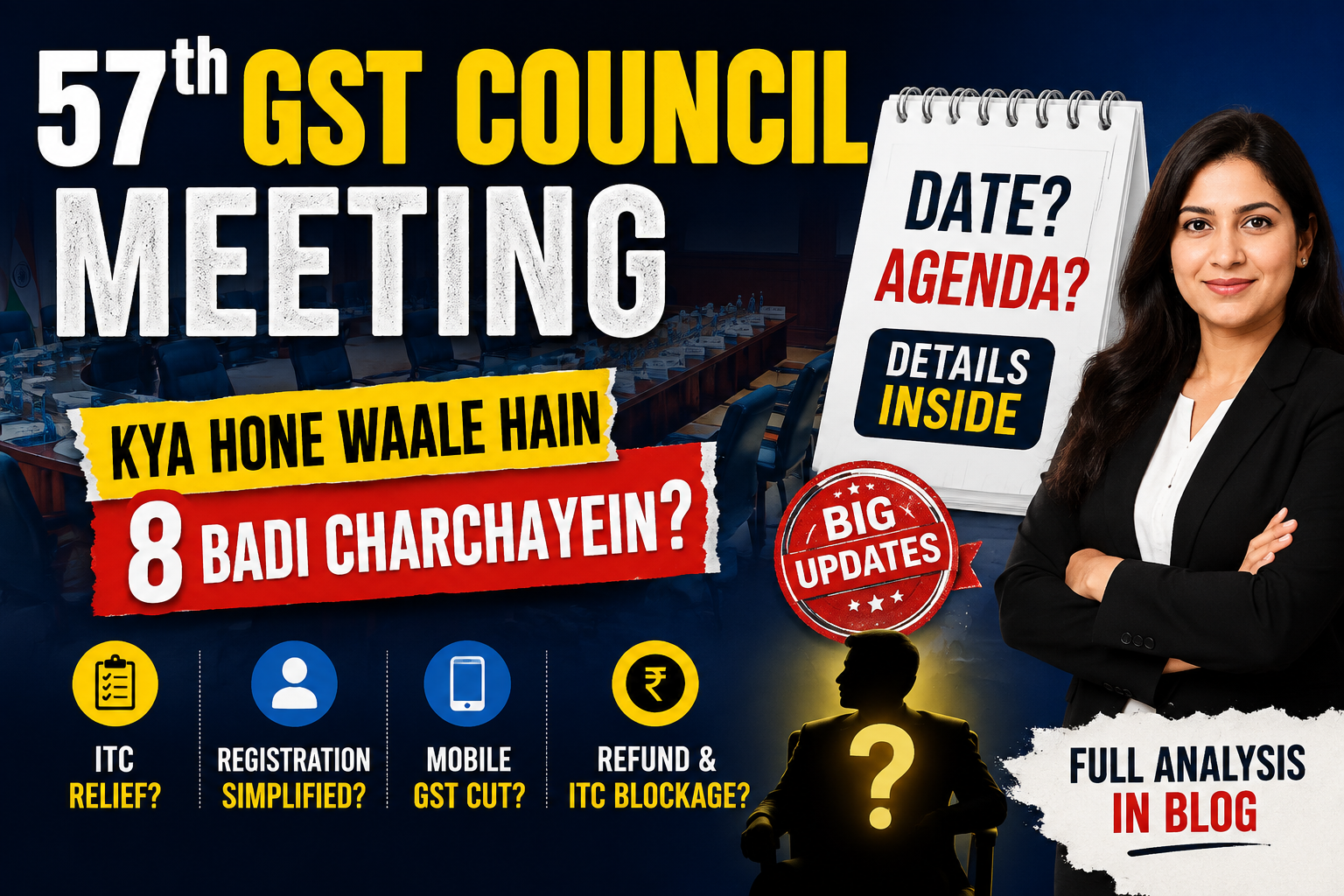
The 57th GST Council Meeting is scheduled to be held on 12 September 2026 in New Delhi. The meeting is expected to discuss several important issues relating to GST compliance, Input Tax Credit (ITC), GST registration, refunds, corporate guarantees and other industry concerns.
According to the official notice issued by the GST Council Secretariat, the 57th GST Council Meeting will be held on Saturday, 12 September 2026, from 11:00 AM onwards. An Officers’ Meeting is scheduled for 11 September 2026 from 11:00 AM onwards.
The detailed agenda of the meeting has not yet been officially released. Therefore, the issues discussed in this article are based on matters reportedly under consideration, industry representations and recent developments. These should not be treated as final GST changes unless and until they are approved by the GST Council and implemented through the required notification, rule amendment or other legal process.
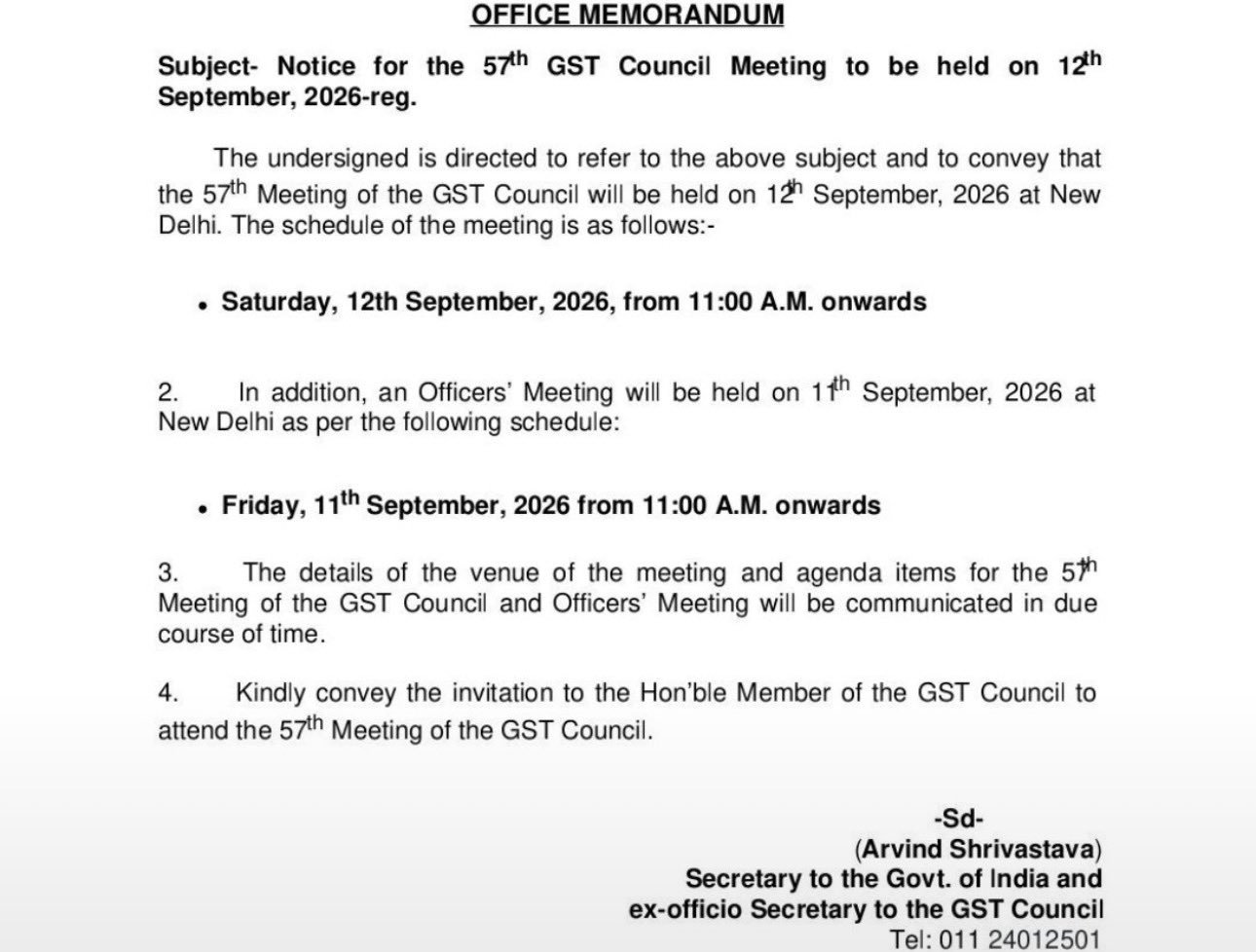
57th GST Council Meeting: Important Dates
| Particulars | Details |
|---|---|
| GST Council Meeting | 57th GST Council Meeting |
| Date | 12 September 2026 |
| Time | 11:00 AM onwards |
| Place | New Delhi |
| Officers’ Meeting | 11 September 2026 |
| Officers’ Meeting Time | 11:00 AM onwards |
The previous, 56th GST Council Meeting was held on 3rd and 4th September 2025.
The long gap between the two meetings makes the upcoming meeting particularly significant for businesses, professionals and GST taxpayers.
Why Is the 57th GST Council Meeting Important?
The 56th GST Council Meeting resulted in major GST rate rationalisation and several important reforms.
The next phase of GST reform is expected to focus more on:
- Simplification of GST compliance
- Reduction in GST litigation
- Input Tax Credit issues
- GST registration
- Refund mechanism
- Ease of doing business
- Clarification of complicated provisions
- Transitional issues arising from earlier GST changes
Several issues have been pending before the GST authorities and industry has been making representations for relief.
The 57th GST Council Meeting could therefore bring important changes for businesses and taxpayers.
1. Major Relief for Genuine Buyers Where Supplier Has Not Paid GST
One of the most important expected reforms relates to Input Tax Credit where the supplier has failed to pay the GST collected from the buyer to the Government.
What is the current problem?
Consider an example.
A purchases goods worth ₹10 lakh from B.
B issues a valid GST invoice and charges GST.
A:
- receives the goods;
- makes payment to B;
- records the purchase in its books;
- receives the invoice in the GST system; and
- claims eligible ITC.
However, B subsequently fails to deposit the GST collected from A with the Government.
This can create a major problem for A because the buyer may face ITC reversal or demand even though the buyer has genuinely purchased the goods and complied with the requirements within its control.
This has been a long-standing issue under the GST framework.
What relief is expected?
A proposal is reportedly being considered to provide greater protection to genuine and bona fide buyers.
Under the proposed mechanism, where the buyer can establish that:
- the transaction is genuine;
- goods or services have actually been received;
- payment has been made;
- the GST component has been paid to the supplier; and
- appropriate documentary evidence is available,
the genuine buyer may be protected from losing ITC merely because the supplier subsequently defaults.
The objective would be to shift the primary recovery focus towards the defaulting supplier, particularly where there is no fraud, collusion or fake transaction on the part of the buyer.
Important
This is currently an expected/proposed reform and not a final change in law.
The exact conditions, documentation and safeguards will be important if such a mechanism is approved.
2. Possible Relief in Blocked ITC Under Section 17(5)
Another major issue expected to be considered is blocked Input Tax Credit under Section 17(5) of the CGST Act.
At present, ITC is restricted on several categories of goods and services, subject to specified exceptions.
These include certain:
- Motor vehicles
- Food and beverages
- Outdoor catering
- Beauty treatment
- Health services
- Club memberships
- Travel-related benefits
- Works contract services and construction-related expenses in specified circumstances
Businesses have been requesting relaxation in some of these restrictions, particularly where the expenditure is directly connected with business activities.
The Council may consider whether some of the existing restrictions need to be rationalised.
However, taxpayers should not start claiming currently blocked ITC merely because a relaxation is expected.
The existing provisions continue to apply until any amendment becomes legally effective.
3. ITC on Employee Health and Life Insurance
Employee-related insurance is another issue that may receive attention.
Many businesses provide employees with:
- Group health insurance
- Group medical insurance
- Group life insurance
- Other employee welfare benefits
The availability of ITC depends upon the nature of the expenditure and the specific provisions of Section 17(5), including applicable exceptions.
Industry has been seeking greater clarity and, in certain circumstances, relaxation in ITC restrictions relating to employee insurance.
If the Council approves any such proposal, it could benefit businesses with a large employee base and significant expenditure on employee insurance.
Again, the final conditions will be important.
4. Corporate Guarantee: Possible Simplification of GST Rules
The GST treatment of corporate guarantees between related parties has been a major area of concern for companies.
Under the existing framework, specific valuation provisions apply to corporate guarantees provided to a banking company or financial institution on behalf of a related person.
The deemed valuation mechanism has generated considerable discussion and litigation.
For example, the existing framework can result in GST implications even where a corporate guarantee is provided without any separate consideration.
What could change?
The industry has been seeking:
- Simplification of valuation;
- Reduction in compliance burden;
- Greater clarity on the taxable value;
- Avoidance of unnecessary working-capital impact;
- Clarity for intra-group transactions.
The 57th GST Council may consider further clarification or simplification of the corporate guarantee provisions.
This will be particularly important for large corporate groups having parent-subsidiary relationships.
5. Simplification of GST Registration
GST registration is another important area where reforms are expected.
The GST registration process has become increasingly technology-driven, but businesses can still face difficulties because of:
- additional verification;
- documentation requirements;
- physical verification;
- differences in practices;
- queries raised by tax authorities;
- delays in approval.
There are reports that the Council may consider further standardisation of the GST registration process.
One of the issues reportedly under consideration relates to businesses with higher monthly output tax liability, where uniformity in the registration process between Central and State authorities may be improved.
The objective would be to make GST registration:
faster + more predictable + standardised + less dependent on manual intervention.
6. Multiple-State GST Registration for Small Businesses
Businesses expanding into multiple States often face a significant compliance burden.
Depending upon the nature of their operations, they may have to maintain separate GST registrations in different States.
This results in:
- Multiple GST returns
- Multiple reconciliations
- Separate GST ledgers
- Separate compliance requirements
- Multiple notices and assessments
- Higher professional and administrative costs
A simplified mechanism for small businesses operating across multiple States has reportedly been under consideration.
If implemented, such a reform could significantly reduce the compliance burden for small businesses that are expanding their operations geographically.
The exact eligibility criteria and legal structure will, however, be critical.
7. Automation of GST Registration Cancellation
Another expected administrative reform is automation of GST registration cancellation.
At present, cancellation can involve manual intervention and different procedures depending upon the circumstances.
A more automated system could potentially provide:
- Standardised cancellation procedures
- System-based processing
- Faster cancellation
- Reduction in manual intervention
- Clearer communication with taxpayers
The GST Council may consider ways to streamline this process.
For taxpayers who have closed their businesses or are no longer liable for GST registration, a simpler cancellation mechanism could reduce unnecessary compliance.
8. Refund of Unutilised ITC and Inverted Duty Structure
Refund of accumulated ITC is another important issue for businesses.
An inverted duty structure occurs when the GST rate on inputs is higher than the GST rate on outward supplies.
This can result in accumulation of ITC and blockage of working capital.
Industries have been seeking improvements in the refund mechanism, particularly with respect to:
- Input services
- Accumulated ITC
- Refund calculation
- Transfer of accumulated credit
- Utilisation of accumulated ITC
- Inverted duty structure
If the GST Council introduces reforms in this area, it could provide significant relief to businesses facing working-capital blockage.
9. Compensation Cess Credit and Transitional Issues
The changes in GST rates and the transition away from the earlier compensation cess structure have created certain practical issues for businesses.
One such concern relates to accumulated compensation cess credit, particularly for sectors such as automobiles.
Businesses that had compensation cess embedded in their inventory before changes in the tax structure may face questions regarding the treatment and utilisation of such credit.
Industry has raised concerns regarding the potential blockage of substantial amounts of credit.
The GST Council may therefore consider transitional issues relating to:
- Existing inventory
- Compensation cess credit
- Credit already accumulated
- Treatment of credit after rate changes
- Working-capital impact
Any relief in this area could be particularly important for affected industries.
10. Mobile Phones: Will GST Reduce From 18% to 5%?
One of the most interesting issues being discussed ahead of the GST Council meeting relates to mobile phones.
At present, mobile phones attract 18% GST.
There have been reports that the GST Council may consider reducing the GST rate on certain mobile phones.
Some reports have specifically mentioned a proposal for 5% GST on mobile phones priced up to ₹25,000.
If such a proposal is approved, it could provide relief to consumers and potentially support the smartphone and electronics sector.
Is 5% GST on mobile phones confirmed?
No.
As of now, this is only a reported proposal/possibility.
Therefore, taxpayers and consumers should not assume that:
“Mobile phones up to ₹25,000 now attract 5% GST.”
The existing rate will continue until an official decision and applicable notification changes it.
The final decision will also need to clarify:
- Applicable price limit
- Product classification
- Effective date
- Treatment of existing stock
- Input Tax Credit implications
11. Will GST Rates Be Reduced Again?
After the major GST rate rationalisation undertaken during the 56th GST Council Meeting, there is considerable interest in whether the 57th meeting will bring another round of rate reductions.
At present, there is no officially confirmed list of GST rate reductions for the 57th meeting.
Therefore, social media claims about specific products becoming cheaper should be treated carefully.
The 56th meeting had already introduced major changes to the GST rate structure, including the broad 5% and 18% rate structure and a special higher rate for specified goods.
Consequently, the focus of the 57th meeting may be more on:
- ITC
- Compliance
- Registration
- Refunds
- Litigation
- Administrative simplification
rather than another broad-based GST rate restructuring.
12. GST Litigation and Legacy Issues
GST litigation remains a major concern for businesses.
Several provisions have resulted in disputes because of:
- Different interpretations;
- Procedural issues;
- Supplier defaults;
- ITC disputes;
- Transitional issues;
- Valuation disputes;
- Classification disputes.
The Council may consider measures to reduce unnecessary litigation and provide greater certainty to taxpayers.
A simpler GST law with clear rules can significantly reduce the compliance cost for businesses.
13. GST Treatment of App-Based Passenger Transport
Another area that may require further clarification relates to app-based passenger transportation services.
With the growth of platforms and different business models, questions can arise regarding:
- Who is liable to pay GST?
- Whether Section 9(5) applies;
- Whether the platform or service provider is responsible;
- Registration requirements;
- Compliance responsibilities.
Further clarification in this area could help both technology platforms and service providers.
14. Petroleum Products Under GST — Will Petrol and Diesel Come Under GST?
Petroleum products have remained outside the GST framework.
There have periodically been discussions about bringing petroleum products under GST, including:
- Petrol
- Diesel
- Aviation Turbine Fuel
- Natural Gas
However, there is currently no confirmed decision that petrol or diesel will be brought under GST from September 2026.
Any such change would require significant discussion because State Governments derive substantial revenue from petroleum taxation.
Therefore, claims that petrol and diesel are definitely coming under GST in the upcoming meeting should not be treated as confirmed.
The 57th GST Council Meeting on 12 September 2026 could be an important meeting for the next phase of GST reforms.
While the previous GST Council meeting focused heavily on GST rate rationalisation, the upcoming meeting is expected to focus significantly on compliance simplification, Input Tax Credit, GST registration, refunds, corporate guarantees and reduction of litigation.
The most important issues to watch are:
- Protection of genuine buyers’ ITC
- Possible relaxation in blocked ITC under Section 17(5)
- Employee insurance ITC
- Corporate guarantee taxation
- GST registration simplification
- Multi-State GST registration
- Automation of registration cancellation
- Refund and unutilised ITC
- Compensation cess transitional issues
- Possible reduction in GST on mobile phones
- GST litigation and legacy issues
However, taxpayers should remember that expected proposals are not the same as final GST law.
The final position should be determined only after the GST Council takes its decision and the relevant notification, circular, rule amendment or statutory amendment is issued.
Therefore, businesses should continue following the existing GST provisions until the changes are officially implemented.
This article will be updated after the official agenda is released and again after the 57th GST Council Meeting to cover the final decisions, effective dates and their practical impact on taxpayers.