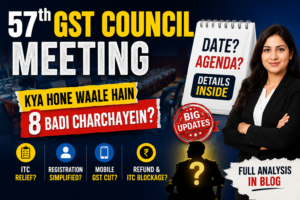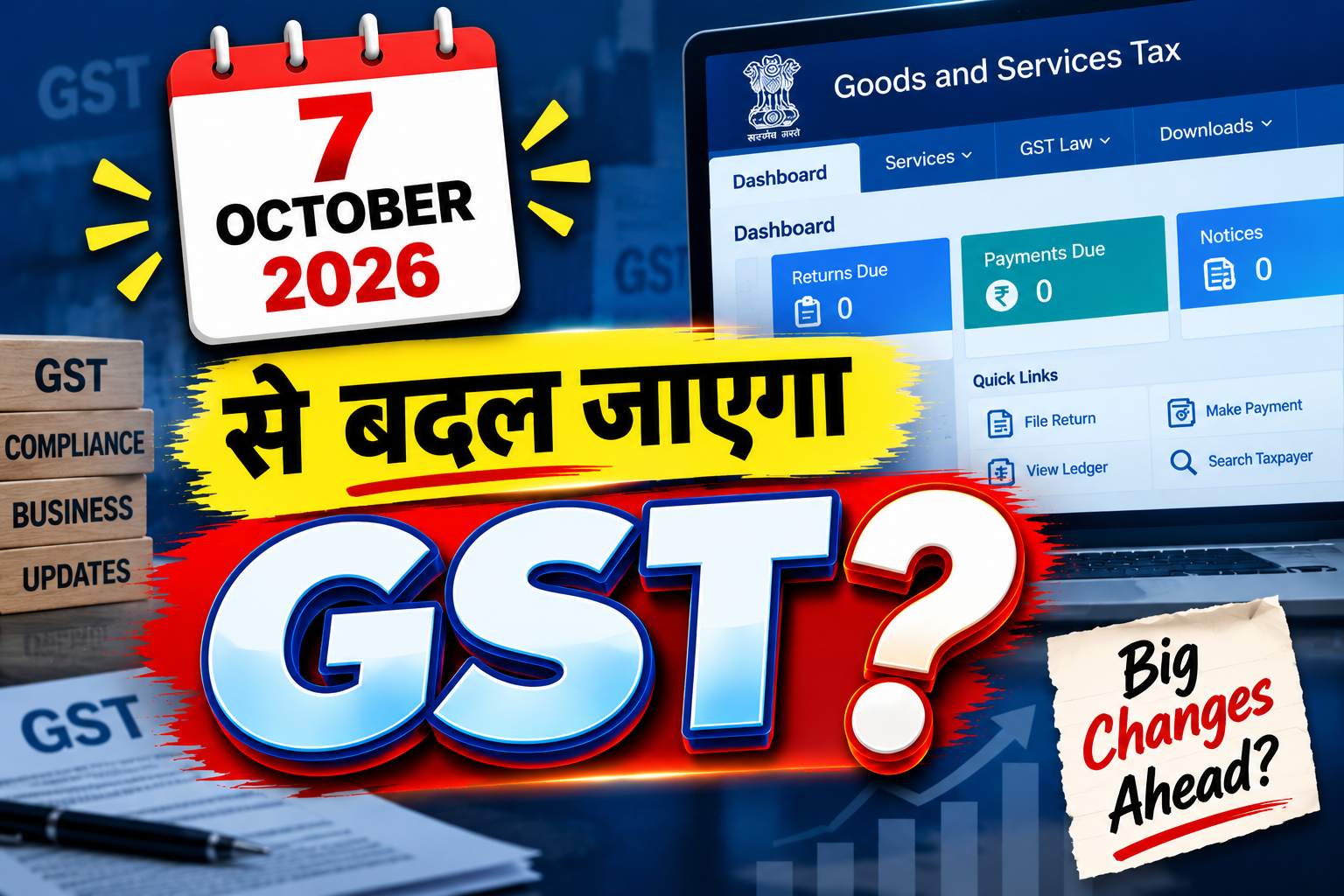
The 57th GST Council meeting, earlier scheduled for 12 September 2026, has been rescheduled to 7 October 2026 in New Delhi. The change coincided with the BRICS Leaders’ Summit scheduled in New Delhi on 12–13 September.
The upcoming meeting is particularly important because it is expected to focus on GST process reforms after the major GST rate rationalisation undertaken in 2025.
Finance Minister Nirmala Sitharaman has said that the October meeting will focus on process reforms, including e-invoicing and input tax credit rules. The government has also invited industry and professionals to identify provisions that create unnecessary complexity or anomalies.
However, there is an important point taxpayers should remember:
These are proposals, representations and issues under consideration—not changes in law yet.
A GST Council recommendation becomes legally effective only after the required legislative, notification or rule-making process.
ITC where supplier has not paid tax — Section 16(2)(c)
One of the most important issues being discussed is the hardship faced by a genuine buyer when the supplier has failed to pay the tax to the Government.
Under the existing Section 16(2)(c), one of the conditions for ITC is that the tax charged on the supply should actually have been paid to the Government, subject to the statutory framework.
This creates a difficult situation for a genuine recipient:
Buyer has:
- received goods/services;
- received a tax invoice;
- paid the supplier;
- complied with other ITC conditions;
but the supplier has failed to deposit/report the tax appropriately.
Industry has been seeking a mechanism that protects a bona fide recipient from losing ITC merely because of a supplier default. This issue has been specifically highlighted in reporting ahead of the Council meeting.
Blocked ITC under Section 17(5)
Another widely discussed issue is blocked ITC under Section 17(5).
The provision currently restricts ITC on specified categories, subject to exceptions—for example, certain motor vehicles, food and beverages, health-related services, club memberships and other specified items. Industry has been seeking reconsideration of some of these restrictions.
“Motor vehicle ITC rules may be reviewed, but taxpayers should not assume that ITC will become available after 7 October unless the Council recommendation is followed by the required legal change.”
Inverted Duty Structure — Refund of accumulated ITC
Another important representation relates to inverted duty structure.
Where the GST rate on inputs is higher than the rate on outward supplies, businesses can accumulate ITC, creating a working-capital blockage.
Industry has been seeking reforms in the refund mechanism and treatment of accumulated ITC.
Reports ahead of the meeting specifically identified refund norms and inverted-duty-related issues among the matters that could receive attention.
This could be particularly relevant for businesses where:
Input GST > Output GST
and substantial credit continues to accumulate.
GST Registration — Simplification
GST registration is another major process-reform area.
Businesses have complained about:
- repeated documentation requirements;
- inconsistent requirements across jurisdictions;
- physical verification;
- delays;
- difficulties in cancellation;
- additional scrutiny of apparently genuine businesses.
The government has already been working on a more uniform registration process for larger businesses, particularly businesses with monthly ITC exceeding ₹2.5 lakh
GST Cancellation Process
Another related reform being discussed is automation/simplification of GST registration cancellation.
The broader reform agenda includes improving registration and cancellation processes so that genuine taxpayers do not remain stuck in procedural loops.
E-Invoicing — Wider Coverage / Process Changes
This is particularly important because the Finance Minister herself has referred to e-invoicing as part of the GST 2.0 process-reform agenda for the October meeting.
There has been discussion about expanding e-invoicing to a wider taxpayer base, including possible consideration of composition taxpayers.
✅ “E-invoicing framework में further expansion और process reforms पर GST Council विचार कर सकती है.”
ITC utilisation across multiple GST registrations
This is one of the interesting issues raised by industry.
For example, a business may have registrations in:
Delhi | Haryana | Maharashtra | Punjab
and may have substantial unused ITC in one registration while another registration has an output tax liability.
The existing GST structure does not simply allow the electronic credit ledger balance of one GST registration to be transferred to another State registration.
Industry has been seeking mechanisms to address such stranded/unutilised ITC across registrations. Reports have identified greater flexibility in utilisation of surplus ITC as one of the issues being considered.
Online Gaming — Legacy GST Disputes
Online gaming is another area where significant legacy disputes exist.
Industry has sought mechanisms to address legacy tax positions and ongoing litigation relating to the earlier GST treatment of online gaming. Reports before the meeting specifically identified regularisation of legacy positions in online gaming as an industry concern.
“Online gaming से जुड़े legacy disputes और litigation के resolution/regularisation पर discussion की संभावना है.”
Compensation Cess — Stranded ITC
This is another important issue after the GST rate rationalisation.
Industry has raised concerns about compensation cess credit embedded in existing inventory, particularly for sectors such as automobiles.
The Indian Express reported that automobile dealers had accumulated substantial ITC linked to the now-abolished compensation cess and were seeking clarity on its treatment.
This makes the issue particularly relevant for:
Automobile dealers + tobacco-related businesses + other sectors affected by compensation cess transition.
“Treatment of stranded compensation-cess credit is an issue industry wants the Council to address.”
One more important point: GST litigation
The October meeting is increasingly being described as a process-reform meeting, and reducing litigation is one of the major themes.
The Finance Minister has specifically invited industry to identify provisions that create unnecessary complexity or anomalies.
Visit www.cagurujiclasses.com for practical courses