By CA Guruji ·
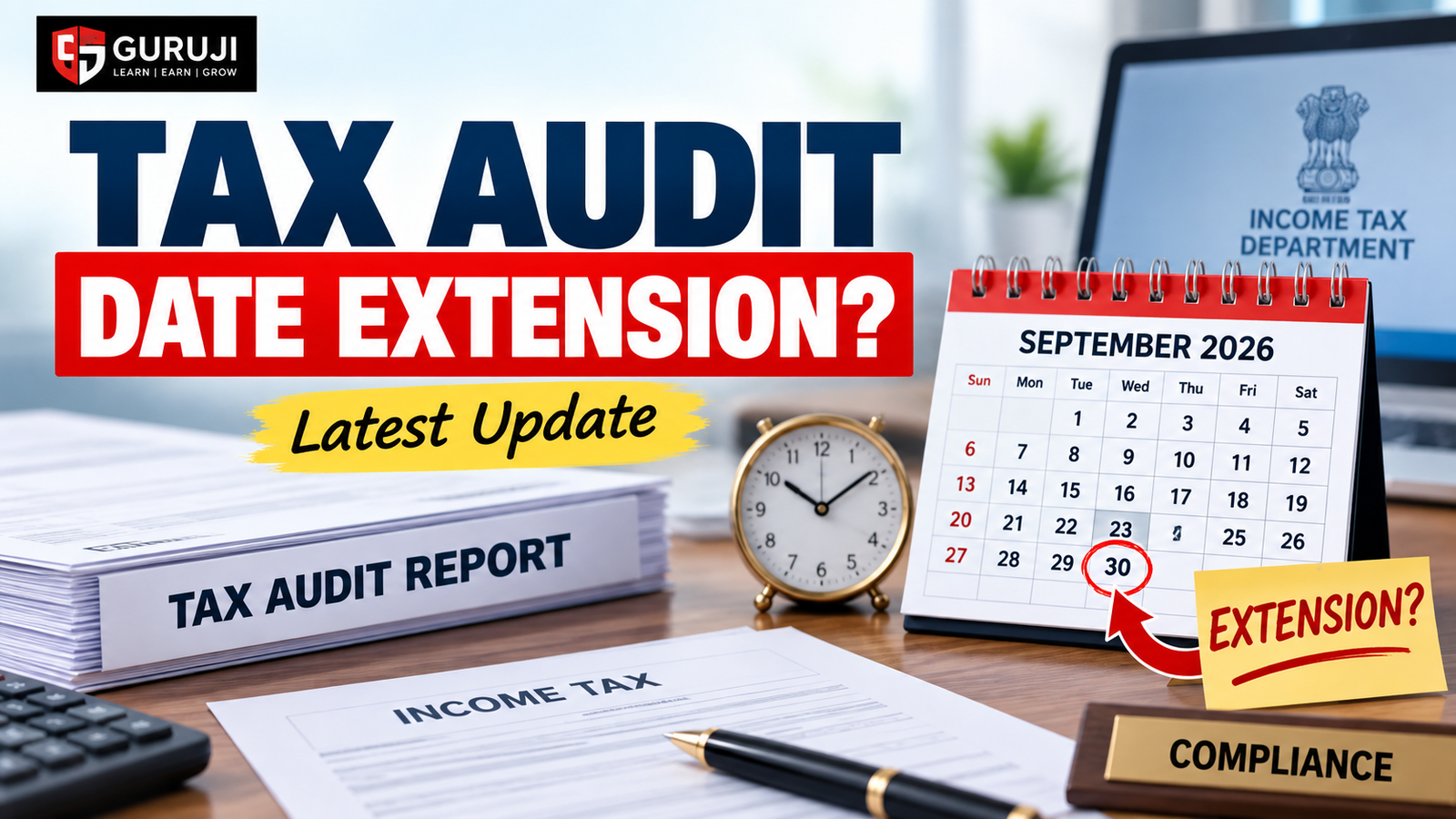
With just over a week left for the tax audit deadline, thousands of Chartered Accountants across India are staring at the same question: will the government extend the 30th September 2026 due date, or not?
As of today, the answer from CBDT is silence.
Current Due Date — No Change Yet
For AY 2026-27 (FY 2025-26), the position remains:
| Compliance | Due Date |
|---|---|
| Tax Audit Report (Form 3CA/3CB-3CD) under Section 44AB | 30th September 2026 |
| ITR filing for audit cases | 31st October 2026 |
| Transfer Pricing cases (Form 3CEB, Section 92E) | Audit: 31st October 2026 / ITR: 30th November 2026 |
No notification extending this has been issued so far. AY 2026-27 continues to be governed by the Income-tax Act, 1961 (the new Income-tax Act, 2025 applies prospectively from FY 2026-27 onwards), so Section 44AB limits and Section 271B penalty provisions apply as usual.
Quick Recap: Who Needs a Tax Audit
| Category | Basic Limit | Enhanced Limit (if cash receipts & payments ≤5% each) |
|---|---|---|
| Business (Sec 44AB) | ₹1 crore | ₹10 crore |
| Profession (Sec 44AB) | ₹50 lakh | — |
| Presumptive business opted out/violated (44AD) | ₹2 crore | ₹3 crore (95%+ digital receipts) |
| Presumptive profession opted out/violated (44ADA) | ₹50 lakh | ₹75 lakh (95%+ digital receipts) |
(Covered in full detail in an earlier post — see “Tax Audit Limits 2026” on the blog for the complete breakdown with examples.)
Why Everyone’s Asking for an Extension
This year, business taxpayers who are not subject to audit had a separate ITR due date of 31 August 2026. Immediately thereafter, the profession moves into the tax-audit season, with the audit report due on 30 September, followed by audit-case ITRs generally due on 31 October.
So, in practice, August and September have become extremely intensive months for tax professionals.
New Income-tax Act transition has increased the complexity
FY 2025-26 / AY 2026-27 is a transition year because the Income-tax Act, 1961 continues to govern AY 2026-27, even though the new Income-tax Act, 2025 has come into force from 1 April 2026.
Importantly, the tax audit for FY 2025-26 still uses Form 3CA/3CB + Form 3CD under the old Act.
This transition itself requires CAs and taxpayers to be careful about which provisions/forms apply to which year.
Delayed availability of ITR forms/utilities
CA associations have specifically cited delayed release/availability of return forms and utilities as one of the reasons for seeking additional time.
For a tax auditor, the audit cannot be treated as simply “check books and upload 3CD.” A lot of information has to be reconciled with the eventual ITR and supporting schedules.
Increased reporting and reconciliation work
The representations mention the additional information and disclosures required, along with the time required for:
- compilation of financial information,
- reconciliation,
- verification,
- preparation of Form 3CD,
- checking tax positions,
- obtaining supporting documents,
- professional review and authentication.
The Chartered Accountants Association, Jalandhar, has specifically cited these additional reporting and verification requirements while requesting extension to 31 October 2026.
Client data itself often comes late
This is a practical issue that doesn’t always appear in the formal representations.
The CA can only complete the audit after receiving:
- final books,
- bank statements,
- GST data,
- TDS/TCS information,
- fixed asset details,
- loans and interest details,
- related-party information,
- stock/inventory details,
- expense ledgers,
- confirmations and other audit evidence.
So even though the legal deadline is 30 September, the effective working period for many auditors is considerably shorter.
Audit report itself is not the end of the process
There is another important practical point: the CA electronically files the tax-audit report, after which the taxpayer has to approve it through the income-tax e-filing account. Therefore, completing the report on 30 September leaves very little buffer for approval-related issues.plan as if 30th September stands. Treat any extension as a bonus, not a backup plan.
What Happens If You Miss It
Missing the tax audit deadline isn’t a technicality — it has real cost:
- Section 271B penalty: 0.5% of turnover/gross receipts, capped at ₹1,50,000
- Reasonable-cause relief under Section 273B exists, but it’s discretionary and needs solid documentation — not a safety net to rely on
- Delayed audit means delayed ITR, which pushes clients into interest under Section 234A on any self-assessment tax due, and can affect their ability to carry forward certain losses
9-Day Action Checklist for Practitioners
- Triage your pending list today — sort clients by complexity, not by who’s asking loudest
- Close data/reconciliation gaps (26AS, AIS, GSTR-2B/3B mismatches) first — these cause the most last-minute delays
- Get Form 3CD annexures and management representation letters signed off in parallel, not after the audit is “done”
- File reports as they’re finalized — don’t batch everything for the last 2 days
- Flag any client who is clearly not going to make it, now, so you can document reasonable cause in real time rather than reconstructing it later
- Keep a screenshot log of portal issues, if any — useful both for 273B relief and for any future extension representation
Quick FAQ
Q: Has the due date been extended to 31st October 2026? No, not as of today. Keep checking for a CBDT notification/circular before assuming otherwise.
Q: Is this the same extension as last year (AY 2025-26)? No — that extension (to 31st October) was for AY 2025-26 and is already over. AY 2026-27 is a fresh cycle with its own (currently unextended) 30th September date.
Q: Should I tell clients to wait for an extension? No. Advise them to proceed as if the date is final. If an extension comes, it only helps you.
Disclaimer: This article is for general awareness based on publicly available information as of 21st September 2026. Please verify the latest CBDT notifications before making compliance decisions, and consult your tax advisor for client-specific situations.
Visit www.cagurujiclasses.com for practical courses