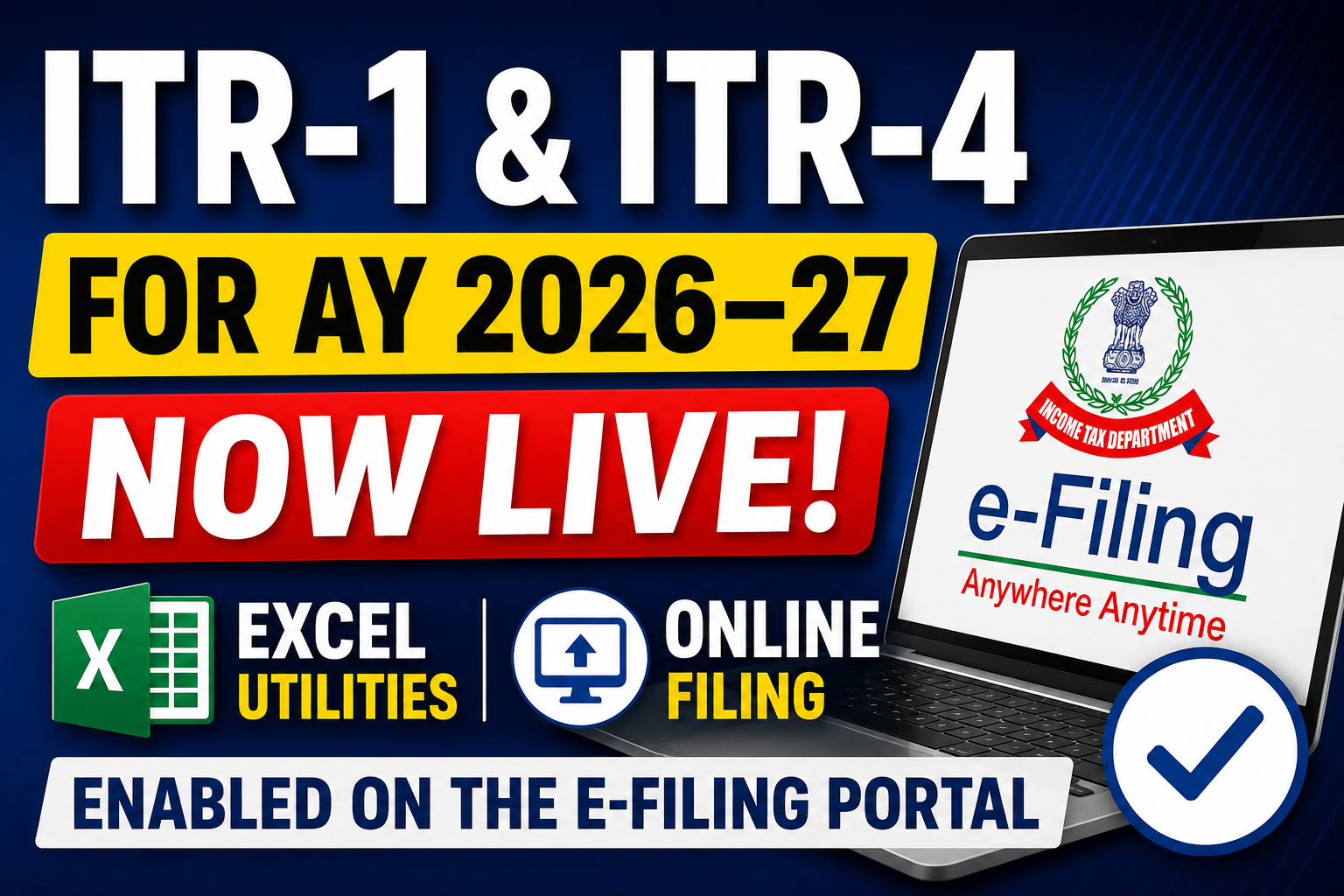
Excel Utilities and Online Filing Enabled
The Income Tax Department has officially enabled ITR-1 (Sahaj) and ITR-4 (Sugam) for Assessment Year 2026–27 on the Income Tax e-Filing Portal. Taxpayers can now start filing their Income Tax Returns using both:
- Online Mode
- Excel Utility
through the official portal of Income Tax Department e-Filing Portal
Big Relief for Salaried Persons & Small Businesses
This update is especially important for:
- Salaried employees
- Pensioners
- Freelancers
- Small business owners
- Professionals under presumptive taxation
- Small taxpayers filing simple returns
Now taxpayers can prepare and submit their returns well before the due date and avoid last-minute portal rush.
Which ITR Forms Are Enabled?
1. ITR-1 (Sahaj)
ITR-1 can be filed by resident individuals having:
- Income from salary/pension
- Two house property
- Other sources (interest etc.)
- Agricultural income up to ₹5,000
- Total income up to ₹50 lakh
Who Cannot File ITR-1?
A taxpayer cannot use ITR-1 if he/she has:
- Capital gains income
- Foreign assets/income
- Business income
- More than one house property
- Director in company
- Unlisted shares investment
2. ITR-4 (Sugam)
ITR-4 is applicable for:
- Resident Individuals
- HUFs
- Firms (other than LLP)
having income under presumptive taxation schemes:
- Section 44AD
- Section 44ADA
- Section 44AE
with total income up to ₹50 lakh.
Suitable For
- Small traders
- Shopkeepers
- Freelancers
- Consultants
- Professionals
- Small transport businesses
Filing Modes Now Available
The Income Tax Department has enabled:
✔ Online Filing
Taxpayers can directly file returns online without downloading utility.
✔ Excel Utility
Users who prefer offline preparation can download the Excel utility, prepare JSON file and upload it on portal.
This is useful for:
- Tax professionals
- CAs
- Bulk return preparation
- Detailed verification before upload
Important Documents Required Before Filing
Before filing ITR, taxpayers should keep ready:
- PAN Card
- Aadhaar Card
- Form 16
- AIS/TIS
- Form 26AS
- Bank statements
- Interest certificates
- Investment proofs
- Home loan certificate (if applicable)
Verify AIS & Form 26AS Carefully
Many taxpayers make mistakes by filing return only on the basis of Form 16.
Before filing, always verify:
- Interest income
- Dividend income
- TDS entries
- Mutual fund transactions
- Stock market transactions
- High value transactions reflected in AIS
Mismatch may result in:
- Income tax notice
- Refund delay
- Defective return notice
New Tax Regime Still Default
For AY 2026–27, the New Tax Regime continues as default regime for individuals.
However, eligible taxpayers can still opt for old regime by filing the required option within prescribed timelines.
Taxpayers should compare:
- Deductions available
- Total taxable income
- Rebate eligibility
- Effective tax liability
before selecting regime.
Due Date for ITR Filing
The due date for filing ITR for most non-audit taxpayers for AY 2026–27 is expected to be:
31st July 2026
However, taxpayers should avoid waiting till last date because:
- Portal traffic increases heavily
- Refund processing may get delayed
- Chances of filing mistakes increase
Benefits of Early ITR Filing
Faster Refund Processing
Early filers generally receive refunds quicker.
Easy Loan Approval
ITR acts as income proof for:
- Home loans
- Car loans
- Business loans
- Visa applications
Avoid Last-Minute Errors
Early filing provides enough time to revise mistakes if required.
Better Financial Planning
Tax liability and refund position become clear early.
How to File ITR-1 or ITR-4?
Step 1
Visit
Income Tax e-Filing Portal
Step 2
Login using PAN and password.
Step 3
Go to:
e-File → Income Tax Return → File Income Tax Return
Step 4
Select:
- Assessment Year: 2026–27
- Applicable ITR Form
Step 5
Choose:
- Online Mode OR
- Offline Utility
Step 6
Validate details and submit return.
Step 7
Complete E-Verification through:
- Aadhaar OTP
- Net banking
- Demat account
- Bank account EVC
Important Advice for Taxpayers
Before final submission:
- Cross-check bank account details
- Verify TDS credit
- Match AIS/TIS data
- Check deduction claims properly
- Confirm tax regime selection carefully
A wrong ITR form or incorrect disclosure may lead to notices from the Income Tax Department.
Conclusion
The activation of ITR-1 and ITR-4 for AY 2026–27 is an important step for taxpayers and professionals. Since both online filing and Excel utilities are now available, eligible taxpayers can start filing returns immediately and avoid last-minute complications.
Early filing not only helps in faster refunds but also reduces chances of notices and errors. Taxpayers should carefully verify all income details before submitting the return.
Visit www.cagurujiclasses.com for practical courses