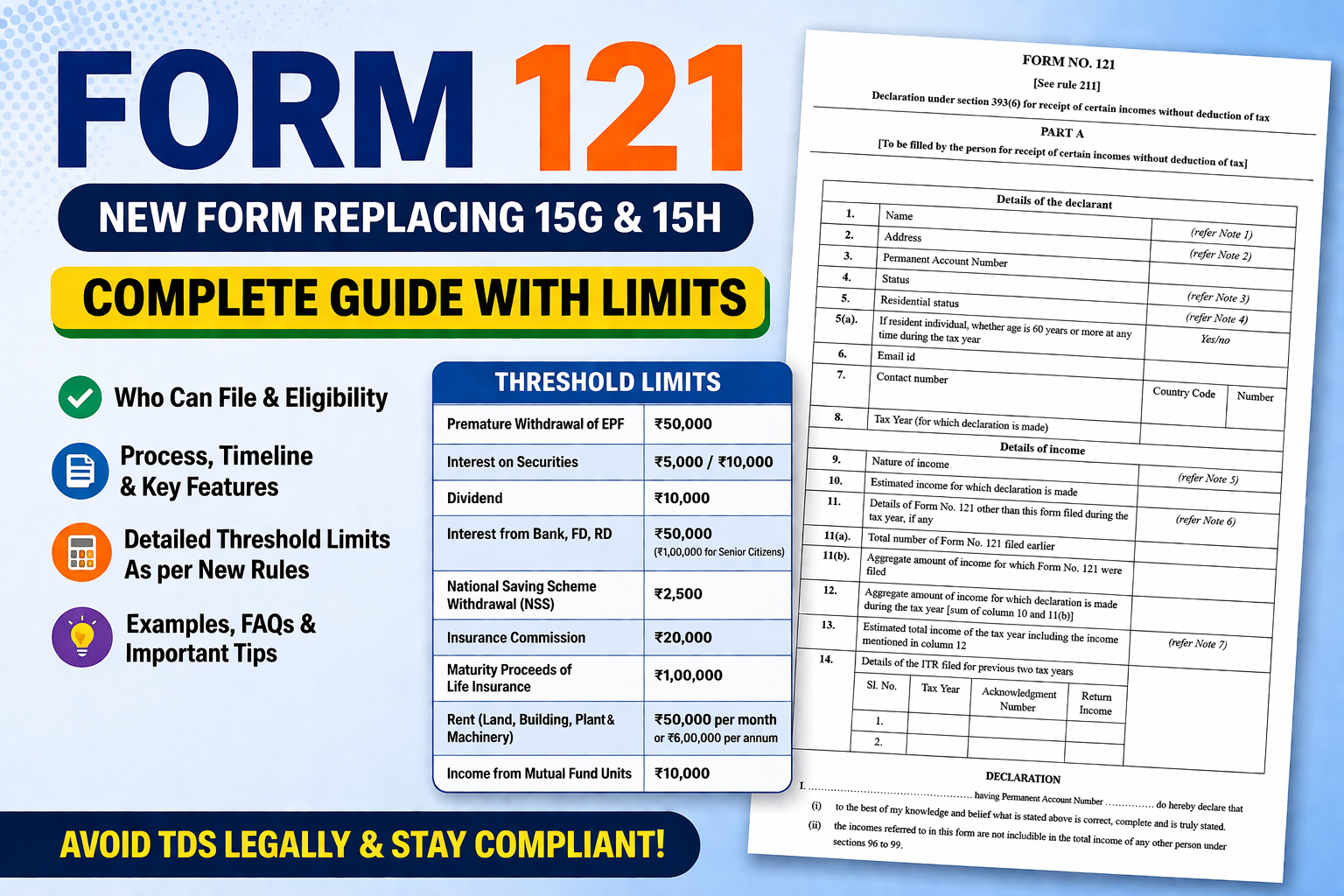
The Income-tax Department has introduced Form 121 under the Income-tax Act, 2025, replacing the earlier Forms 15G & 15H. This new form simplifies the process of declaring NIL tax liability to avoid TDS deduction.
It is governed by Section 393(6) and Rule 211.
🎯 Purpose of Form 121
Form 121 is used to declare that:
👉 Your estimated total income is below taxable limit
👉 Therefore, no TDS should be deducted
👤 Eligibility
✅ Allowed:
- Resident Individuals (all age groups)
- HUFs
❌ Not Allowed:
- Companies
- Firms
- Non-residents
👉 Condition: Final tax liability must be NIL
📊 Incomes for which Form 121 can be filled
Below are the important income-wise limits where Form 121 becomes relevant for avoiding TDS:
| S. No. | Nature of Payment | Threshold Limit (Financial Year) |
|---|---|---|
| 1 | Premature withdrawal of EPF | ₹50,000 |
| 2 | Interest on securities (debentures, govt. bonds, etc.) | ₹5,000 / ₹10,000 |
| 3 | Dividend income | ₹10,000 |
| 4 | Interest from Bank, FD, RD | ₹50,000 (₹1,00,000 for senior citizens) |
| 5 | National Saving Scheme (NSS) withdrawal | ₹2,500 |
| 6 | Insurance commission | ₹20,000 |
| 7 | Maturity proceeds of life insurance | ₹1,00,000 |
| 8 | Rent (land/building/plant/machinery) | ₹50,000 per month OR ₹6,00,000 annually |
| 9 | Income from mutual fund units | ₹10,000 |
👉 These limits are important triggers for TDS, and Form 121 helps avoid deduction only if tax liability is NIL.
⚠️ Important Practical Point (Very Important)
Even if your income crosses above limits:
👉 TDS applies
👉 BUT if your total income is still below taxable limit, you can submit Form 121
✔ Example:
- FD Interest = ₹60,000 (above ₹50,000 limit)
- Total income after deductions = ₹2,00,000
👉 Still eligible for Form 121 (because tax = NIL)
📋 Structure of Form 121
🧾 Part A (By Taxpayer)
- PAN, Name, DOB
- Estimated income
- Nature of income (interest, rent etc.)
- Total income estimate
- ITR filing details (last 2 years)
🏦 Part B (By Payer)
- TAN, PAN
- UIN (Unique Identification Number)
- Declaration records
📅 Filing Timing
| Activity | Timeline |
|---|---|
| Submission by taxpayer | Before income is credited |
| Monthly reporting by payer | By 7th of next month |
| TDS return reporting | Quarterly |
🔄 Process Flow
👨💼 Taxpayer:
- Check eligibility (tax NIL)
- Fill Form 121
- Submit to bank/payer
- Submit separately to each payer
🏦 Payer:
- Verify form
- Generate UIN
- Upload monthly statement
- Report in TDS return (Form 140)
🧮 Practical Examples
📌 Example 1: Bank Interest Case
Interest = ₹70,000
Deductions = ₹2,00,000
👉 Taxable income below limit
✔ Submit Form 121
✔ No TDS
📌 Example 2: Rent Case
Rent received = ₹60,000/month
👉 TDS applicable (above ₹50,000/month)
BUT
Total income after deductions = NIL
✔ Form 121 can be submitted
✔ No TDS
📌 Example 3: Wrong Declaration
Dividend = ₹2,00,000
Total taxable income = ₹8,00,000
❌ Cannot file Form 121
❌ If filed → penalty risk
⚙️ Key Features of New Form 121
- Single unified form (15G + 15H merged)
- Smart pre-filled system
- Real-time validation
- AIS integration
- UIN tracking system
❗ Important Compliance Notes
- PAN is mandatory
- Separate form for each payer
- Valid only for one financial year
- Income must still be reported in ITR
- Incorrect declaration may attract penalties