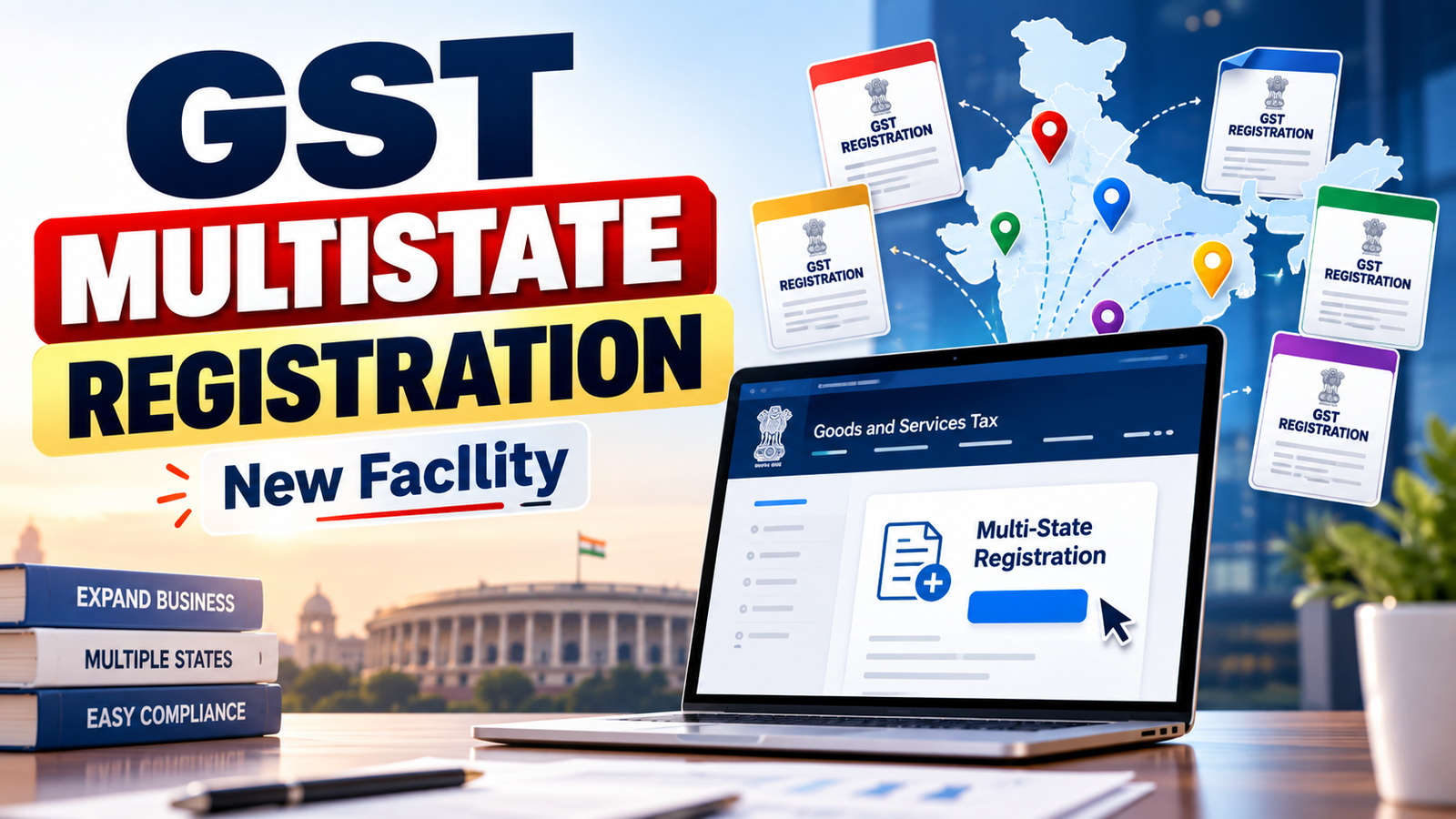
GSTN introduces a new facility to apply for GST registration in multiple States/UTs through a single registration process
Date of introduction: 1 October 2026
GST registration has become significantly easier for businesses that need registrations in more than one State or Union Territory.
GSTN has introduced a new “Multistate Registration” facility on the GST Common Portal. The new functionality enables taxpayers having the same PAN to initiate GST registration applications for multiple States/UTs simultaneously instead of entering the common registration details separately for every State.
The facility is currently available only for Normal Taxpayers.
This new functionality is designed to reduce repetitive data entry and make the GST registration process more convenient for businesses operating across multiple States and Union Territories.
What is the New Multistate Registration Facility?
Under the new facility, a taxpayer who wants to obtain GST registration in multiple States/UTs can select the required States/UTs together through a dedicated “Multistate Registration” option available on the GST Common Portal.
Instead of starting completely separate registration processes for every State, the applicant can first provide the common information through a Master TRN.
Once the common registration information is submitted, the system generates individual State-specific TRNs for each selected State/UT.
This means that the common information does not have to be entered repeatedly for every State registration application.
Who Can Use the Multistate Registration Facility?
The facility can be used by taxpayers who:
- Require GST registration in more than one State/UT;
- Have the same PAN for the registrations; and
- Fall under the category of Normal Taxpayer.
As per the GSTN advisory, the functionality is currently available only for Normal Taxpayers.
Therefore, taxpayers should note that this facility is not presently described as a general-purpose registration facility for every type of taxpayer.
Where is the New Option Available?
A new “Multistate Registration” tab has been introduced on the homepage of the GST Common Portal.
Through this option, the applicant can select the multiple States/UTs in which GST registration is required.
After selecting the required States/UTs, the system generates a Master Temporary Reference Number (Master TRN).
The Master TRN becomes the starting point for providing the common information required for the selected registrations.
What is a Master TRN?
A Master TRN, or Master Temporary Reference Number, is generated after the applicant selects the States/UTs for which GST registration is required.
The Master TRN is used for entering and submitting the Common Registration Information (CRI) for all the selected States/UTs.
The applicant therefore does not have to separately enter the same common information for each State at the initial stage.
This is one of the most important features of the new functionality.
What is Common Registration Information (CRI)?
After generation of the Master TRN, the applicant can provide the Common Registration Information (CRI).
As specified in the GSTN advisory, the common information includes details such as:
1. Business Details
The applicant provides the relevant information relating to the business.
2. Promoter/Partner Details
Details relating to promoters or partners can be provided as part of the common registration information.
3. Authorised Signatory
The details of the authorised signatory are also part of the common information.
4. Authorised Representative
Where applicable, details of the authorised representative can be provided.
5. Goods and Services
Details relating to the goods and services of the business are also included in the common registration information.
The important point is that this information is entered at the common stage instead of being repeatedly entered for each State registration.
Important: Master TRN Must Be Submitted Within 15 Days
The GSTN advisory specifically provides that the Master TRN is required to be submitted within 15 days.
Therefore, generating the Master TRN should not be treated as completion of the registration application.
The applicant must proceed with the Master TRN and submit the common registration information within the prescribed 15-day period.
Practical point
Businesses should therefore keep the required information and documents ready before initiating the Multistate Registration process.
There is little benefit in generating the Master TRN and then delaying the submission of the common information.
What Happens After Submission of the Master TRN?
This is where the new facility becomes particularly useful.
Once the Common Registration Information (CRI) has been submitted through the Master TRN, the GST portal generates individual TRNs for each selected State/UT.
For example, suppose a business wants GST registration in:
Delhi + Haryana + Maharashtra + Karnataka
The applicant can select all the required States through the Multistate Registration facility.
The system first generates:
One Master TRN
↓
Common Registration Information is submitted
↓
Individual State-specific TRNs are generated
↓
Separate State registration applications are completed
Thus, the applicant does not have to start from the beginning for every State.
What Information Gets Auto-Populated in State-Specific Applications?
After individual State-specific TRNs are generated, the common information already provided through the CRI is auto-populated in the respective State registration application.
The GSTN advisory also clarifies that the information remains editable.
This is important because although the basic/common information is carried forward automatically, the applicant may need to review or modify information wherever necessary before submitting the State-specific application.
What Information Has to Be Provided Separately for Each State?
Although the common information is carried forward, every State/UT registration still requires certain State-specific information.
The applicant is required to provide the remaining information for the respective State/UT.
This includes:
Principal Place of Business (PPoB)
The applicant has to provide the details of the Principal Place of Business relevant to the particular State registration.
Additional Place of Business (APoB)
Where applicable, details of the Additional Place of Business have to be provided.
State-Specific Information
The applicant must provide the information specifically required for the particular State/UT registration.
Aadhaar Authentication
The applicable Aadhaar authentication requirement has to be completed for the respective registration application.
Therefore, the new facility does not mean that one GST registration number will be issued for multiple States.
Instead, it simplifies the application process by allowing the common information to be entered once and then carried forward to the individual State applications.
Master TRN vs State-Specific TRN
The process can be understood easily by distinguishing between the two types of TRNs.
| Particular | Master TRN | State-Specific TRN |
|---|---|---|
| Purpose | Initiates common registration process | Individual State/UT registration |
| Generated | After selecting multiple States/UTs | After submission of CRI |
| Common information | Entered here | Auto-populated |
| PPoB | Not the State-specific stage | Required |
| APoB | Not the State-specific stage | Required, where applicable |
| State-specific details | Not applicable at common stage | Required |
| Aadhaar authentication | Part of overall process | Required for respective application |
The Master TRN therefore acts as the common starting point, while the individual TRNs take the application forward for each selected State/UT.
The Biggest Advantage: No Repetitive Data Entry
The most important benefit of the new facility is the reduction in repetitive data entry.
Earlier, where a business needed GST registrations in multiple States, the applicant had to go through separate registration applications and repeatedly enter common business information.
For a business having multiple registrations, this could mean repeatedly entering details relating to:
- Business;
- Promoters/partners;
- Authorised signatory;
- Authorised representative; and
- Goods and services.
With the new Multistate Registration functionality, these common details can be entered through the Common Registration Information once and then carried forward to the State-specific applications.
This can significantly simplify the registration workflow for businesses with a multi-State presence.
Does Multistate Registration Mean One GSTIN for All States?
No.
This is an important distinction.
The new facility is a mechanism for applying for registrations in multiple States/UTs simultaneously.
It does not convert multiple State registrations into one GSTIN.
After the Master TRN and CRI process, individual State-specific TRNs are generated, and the applicant completes the registration process for each respective State/UT.
Therefore, the facility simplifies the application process, not the fundamental State-wise GST registration structure.
Example of the New Multistate Registration Process
Let us understand the process with a simple example.
Suppose ABC Private Limited has its PAN and wants GST registration in:
Haryana, Delhi, Maharashtra and Karnataka.
Step 1 – Select States
ABC Private Limited accesses the Multistate Registration option on the GST portal and selects the four required States.
Step 2 – Master TRN
The GST portal generates a Master TRN for the selected States.
Step 3 – Enter Common Information
Using the Master TRN, the applicant provides the Common Registration Information, including business details, promoter/director/partner details as applicable, authorised signatory, authorised representative and goods/services.
Step 4 – Submit Master TRN
The Master TRN is required to be submitted within 15 days.
Step 5 – State-Specific TRNs
Once the CRI is submitted, the system generates separate TRNs for:
- Haryana
- Delhi
- Maharashtra
- Karnataka
Step 6 – Complete State-Specific Applications
The common information is automatically populated into the respective applications.
The applicant then provides the remaining information, such as:
- Principal Place of Business;
- Additional Place of Business, wherever applicable;
- State-specific information; and
- Aadhaar authentication.
Thus, the business does not have to repeat the entire common registration process separately for every State.
Why This Feature Is Important for Businesses
The new facility can be particularly useful for businesses that operate across multiple States.
For example, businesses having:
- Branches in multiple States;
- Warehouses in different States;
- Manufacturing units in different States;
- Offices across India;
- Distribution networks across States; or
- Multiple State-wise business establishments
may need GST registrations in several States/UTs.
For such businesses, repetitive data entry during registration can be time-consuming.
The Multistate Registration facility addresses this issue by creating a common registration workflow.
What Remains State-Specific?
Even after the introduction of the facility, applicants must remember that certain information remains specific to each State/UT.
The GSTN advisory specifically identifies:
Principal Place of Business + Additional Place of Business + State-Specific Information + Aadhaar Authentication
as part of the information that has to be dealt with at the individual State application stage.
Therefore, applicants should keep State-wise information ready before starting the process.
For example, if a business has different warehouses in Haryana and Maharashtra, the relevant business-place details for each State would still have to be provided in the respective State application.
What Does This Mean for Tax Professionals?
The new functionality is also relevant for CAs, tax consultants and professionals handling GST registrations.
Instead of preparing completely separate common-data sets for every State registration, professionals can structure the registration exercise in two stages:
Stage 1 – Common Information
Prepare and verify:
- Business details;
- Promoter/partner details;
- Authorised signatory;
- Authorised representative; and
- Goods and services.
Stage 2 – State-Wise Information
Prepare separately:
- PPoB;
- APoB;
- State-specific details; and
- Aadhaar authentication requirements.
This makes the registration process more organised and reduces the possibility of repeatedly entering the same information.
Important Points to Remember
Before using the new Multistate Registration facility, taxpayers should keep the following points in mind:
1. Currently available for Normal Taxpayers
As per the GSTN advisory, the functionality is currently available only for Normal Taxpayers.
2. Same PAN
The facility is intended for applications for multiple States/UTs under the same PAN.
3. Master TRN is only the starting point
Generation of the Master TRN does not complete GST registration.
The applicant must submit the CRI and then complete the individual State applications.
4. 15-day submission requirement
The Master TRN must be submitted within 15 days.
5. State-wise information is still required
PPoB, APoB, State-specific information and Aadhaar authentication continue to be part of the individual State registration process, as applicable.
6. Common information is auto-populated
After submission of CRI, the common information is auto-populated into the State-specific applications.
7. Auto-populated information remains editable
The applicant should carefully review the information before proceeding because the auto-populated information remains editable.
How Does the New Facility Improve Ease of Doing Business?
The primary objective of the facility is to reduce repetitive data entry.
For a business seeking registration in multiple States, entering the same business information repeatedly can increase both the time required and the possibility of inconsistencies between applications.
The new process allows common information to be entered once and then used across the selected State/UT applications.
Therefore, the facility can make the GST registration process more streamlined and convenient, particularly for businesses expanding into multiple States.
The introduction of the Multistate Registration facility is an important GST portal enhancement for businesses requiring registration in multiple States or Union Territories.
The biggest change is that taxpayers can initiate registrations for multiple States/UTs through a common process. A Master TRN is generated after selecting the required States/UTs, and the applicant can then provide the Common Registration Information covering details such as business, promoters/partners, authorised signatory, authorised representative and goods/services.
Once the Master TRN is submitted, individual State-specific TRNs are generated. The common information is then auto-populated into the respective State applications, while State-specific details such as the Principal Place of Business, Additional Place of Business, State-specific information and Aadhaar authentication are completed separately.
The facility therefore does not eliminate separate State-wise GST registrations. Instead, it makes the application process simpler by eliminating repetitive entry of common information.
For businesses operating across multiple States, and for professionals handling multiple GST registrations, this can make the registration workflow considerably more efficient.
In simple words:
One Master TRN → Common Information Once → Individual State TRNs → State-wise GST Registration
The facility is currently available for Normal Taxpayers, and taxpayers should follow the latest instructions available on the GST Common Portal while using the functionality.
Source: GSTN Advisory on “Multistate Registration” Facility for GST Registration, dated 1 October 2026.
Visit www.cagurujiclasses.com for practical courses