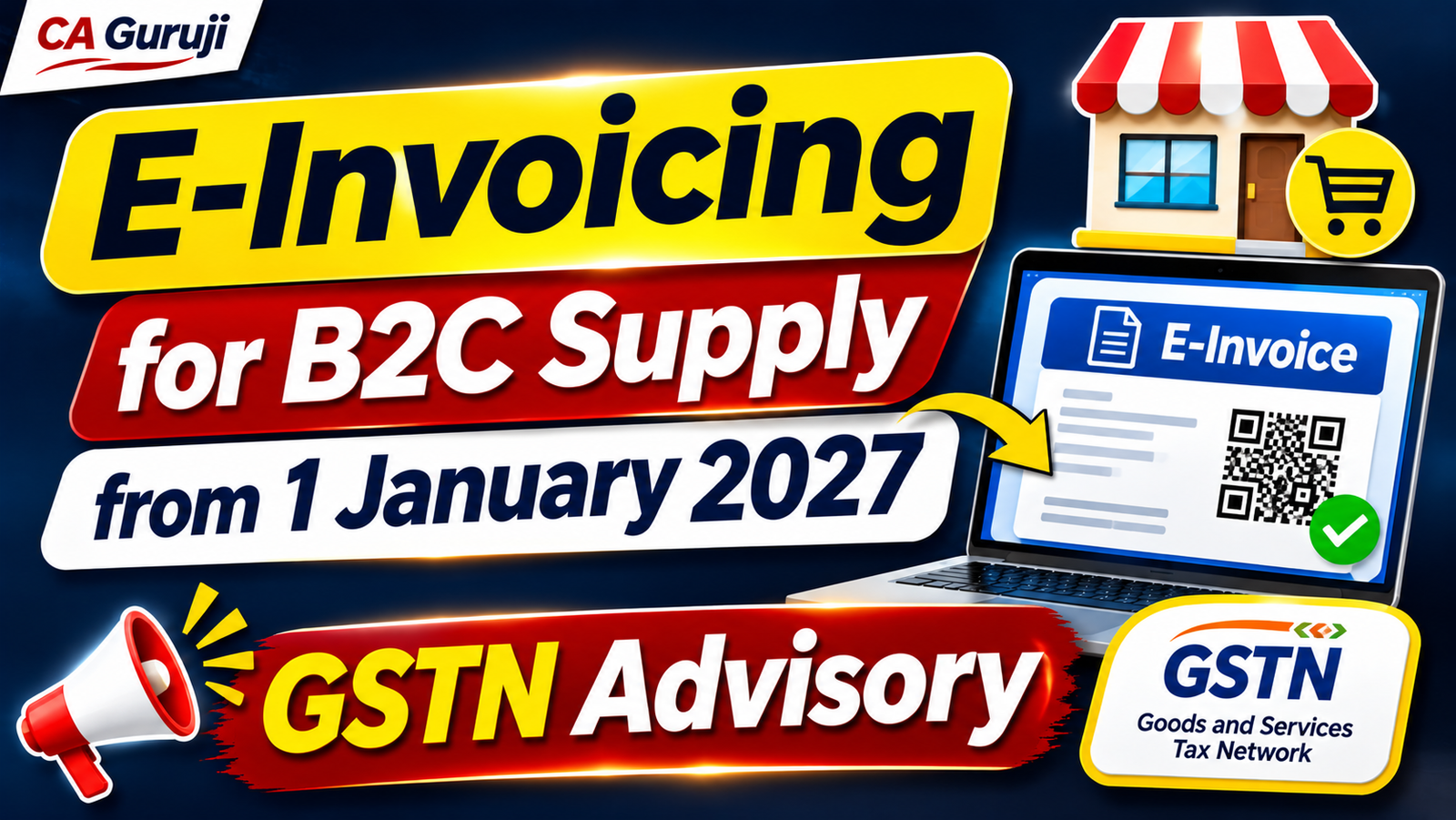
From 1 January 2027, e-invoicing will be mandatory for two RCM self-invoices. The first is the self-invoice for purchases from unregistered persons (supply type RCMDOM). The second is the self-invoice for import of services (RCMIMP). This applies to taxpayers already covered under e-invoicing.
GSTN issued a fresh advisory on 17 November 2026. It confirms that the facility will open on the live e-invoice portals (IRPs) from 15 December 2026 for voluntary use. It will become compulsory from 1 January 2027 under Notification No. 04/2026-Central Tax dated 26 October 2026.
So businesses with turnover above ₹5 crore have about six weeks to update their ERP, accounting software and RCM process. In this article we explain:
- what the advisory says
- who is covered
- the key dates
- how it affects self-invoicing and ITC
- a practical checklist
Background: the notifications and advisories
The change comes from two notifications dated 26 October 2026 and two GSTN advisories.
| Document | Date | What it does |
|---|---|---|
| GSTN advisory | 16 Oct 2026 | Introduced RCMDOM and RCMIMP and opened them in the sandbox of all six IRPs for testing |
| Notification No. 04/2026-Central Tax | 26 Oct 2026 | Amends Notification 13/2020-CT (issued under Rule 48(4)) to extend e-invoicing to RCM purchases from unregistered persons and import of services, from 1 Jan 2027 |
| Notification No. 05/2026-Central Tax | 26 Oct 2026 | Amends the CGST Rules and updates the e-invoice schema (FORM GST INV-01) with the new supply types |
| GSTN advisory | 17 Nov 2026 | Confirms production rollout from 15 Dec 2026 (voluntary), mandatory from 1 Jan 2027 |
Who is covered, and what RCMDOM and RCMIMP mean
The new rule applies only to taxpayers who are already required to issue e-invoices. Those are registered persons whose aggregate turnover exceeded ₹5 crore in any financial year from 2017-18 onwards. The threshold has not changed. Entities exempt from e-invoicing under Notification 13/2020-CT, such as banks, insurers, GTAs, SEZ units and government departments, should confirm their position from the notification text.
Under Section 31(3)(f), when you pay tax under RCM on a purchase from an unregistered supplier, or on import of services, you must issue a self-invoice. From 1 January 2027, covered taxpayers must generate an IRN for this self-invoice through an IRP.
| Supply type | Meaning | Common examples |
|---|---|---|
| RCMDOM | Domestic supply received from an unregistered person, where you pay tax under RCM (Section 9(3) or 9(4)) | Commercial rent paid to an unregistered landlord; legal fees to an unregistered advocate; GTA services from an unregistered transporter; goods or services bought by a promoter from unregistered suppliers |
| RCMIMP | Import of services, where you pay IGST under RCM | Fees to a foreign consultant; software or cloud subscriptions billed from abroad; foreign advertising or marketing services |
Not covered:
- Import of goods. It continues through the customs Bill of Entry route.
- RCM purchases from registered suppliers. Here the supplier issues the tax invoice.
- Businesses with turnover up to ₹5 crore. They continue issuing self-invoices without an IRN.
Key dates from the 17 November advisory
The IRN for RCMDOM and RCMIMP becomes compulsory only from 1 January 2027. Between 15 and 31 December 2026 it is optional.
| Date | What happens |
|---|---|
| 16 Oct 2026 onwards | Sandbox testing available on all six authorised IRPs |
| 15 Dec 2026 | Live (production) IRPs start accepting RCMDOM and RCMIMP; voluntary use only |
| 15 – 31 Dec 2026 | Optional: generate IRN on genuine self-invoices to test your process |
| 1 Jan 2027 | E-invoicing mandatory for RCMDOM and RCMIMP self-invoices of covered taxpayers |
Three more points from the advisory:
- Document date rule: the live system will accept RCMDOM and RCMIMP documents dated 15 December 2026 or later only. Older self-invoices cannot get an IRN.
- Sandbox for testing, production for real data: test with sample data only in the sandbox. Use the live portal only for genuine transactions, because an IRN generated there is a real document.
- Technical specifications: validations, error codes and schema details are on the NIC e-Invoice API Developer Portal. Software vendors and ERP teams should follow the NIC IRP-1 release notes.
Practical impact on self-invoicing and ITC
The biggest impact is on ITC: from 1 January 2027, a covered taxpayer’s RCM self-invoice without a valid IRN may not count as a valid invoice.
1. Two 30-day clocks, not one 60-day buffer
- Rule 47A (issuing the self-invoice): since 1 November 2024, every registered recipient must issue the RCM self-invoice within 30 days of receiving the goods or services, whatever the turnover.
- IRP reporting window: taxpayers with AATO of ₹10 crore or more cannot report an invoice to the IRP more than 30 days after its date. GSTN has not yet confirmed whether this window applies to RCMDOM and RCMIMP, so plan as if it does
2. ITC risk. Under Rule 48(5), an invoice that must be e-invoiced but is issued without an IRN is not treated as an invoice. RCM ITC claimed on such a self-invoice can be questioned. The tax paid under RCM will still be payable.
3. Returns. RCM liability continues in Table 3.1(d) of GSTR-3B, payable only in cash. ITC goes in Table 4(A)(3)(inward supplies under RCM) or 4(A)(2) (import of services). The advisory does not say whether e-invoiced self-invoices will auto-populate any return. Until GSTN clarifies, keep reporting them as you do now.
4. Process change. Today, many businesses prepare RCM self-invoices at month-end from the ledger, or only at the time of filing GSTR-3B. That will not work after 1 January. Each self-invoice must be raised in the accounting or ERP system, with the IRN generated and the QR code saved on the document.
Action checklist before 1 January 2027
- Check applicability. Confirm whether the client’s AATO crossed ₹5 crore in any year since 2017-18, and whether it crossed ₹10 crore (for the 30-day IRP window).
- List all RCM transactions from FY 2025-26. Separate purchases from unregistered persons (rent, advocate, GTA, others) and import of services. These become your RCMDOM and RCMIMP volumes.
- Talk to your software vendor or GSP. Confirm that your ERP or e-invoice tool supports schema version 1.2 and the RCMDOM and RCMIMP supply types. Test in the sandbox now.
- Collect master data. Keep the unregistered supplier’s name, address and state, the place of supply, and the HSN/SAC ready for each vendor. For import of services, keep foreign vendor details.
- Fix the timing. Raise the self-invoice and generate the IRN within a few days of receipt; an internal target of 7 days leaves room for errors. Do not keep it for month-end.
- Use 15–31 December for a live trial. Generate IRNs on a few genuine self-invoices dated on or after 15 December to check the flow end to end.
- Train the accounts team on the new step and update the RCM SOP.
- Update ITC controls. From January 2027, claim RCM ITC only where a valid IRN exists for covered taxpayers.
Frequently asked questions
Q1. My turnover is ₹4 crore. Do I need to generate IRN for RCM self-invoices? No. Only taxpayers already covered under e-invoicing (AATO above ₹5 crore in any year since 2017-18) are covered. You still must issue the self-invoice within 30 days under Rule 47A.
Q2. Is it mandatory from 15 December 2026? No. From 15 to 31 December it is voluntary. It becomes mandatory from 1 January 2027.
Q3. Can I generate IRN for a self-invoice dated 10 December 2026? No. The live system accepts RCMDOM and RCMIMP documents dated 15 December 2026 or later only.
Q4. I pay office rent to an unregistered landlord. Is this covered? Yes, if you are an e-invoicing taxpayer. Commercial rent paid to an unregistered person is under RCM, and its self-invoice falls under RCMDOM.
Q5. Does this apply to import of goods? No. Only import of services (RCMIMP) is covered. Import of goods continues through the Bill of Entry.
Q6. My supplier is registered, but the service is under RCM (for example a registered GTA or advocate). Is a self-invoice needed? No. The registered supplier issues the invoice. RCMDOM is only for supplies from unregistered persons.
Q7. What if I miss generating the IRN after 1 January 2027? The self-invoice may not be treated as a valid invoice under Rule 48(5). That puts the RCM ITC at risk, and penalties for invoice defaults may apply.
Conclusion
RCM self-invoices have long been an afterthought, often made at month-end only for the file. From 1 January 2027, for e-invoicing taxpayers, they become real-time documents with an IRN, and RCM ITC depends on it.
Use the sandbox now and the voluntary window from 15 December. Then fix the process before the deadline, not after the first rejected ITC claim.
To master RCM end to end, from notified goods and services to self-invoicing, ITC and return reporting, check our RCM ebook and GST courses at cagurujiclasses.com. For daily GST and income tax updates, keep visiting cagurujitax.comand subscribe to CA Guruji on YouTube.
Disclaimer: This article is based on the GSTN advisory dated 17 November 2026 and Notifications 04/2026 and 05/2026-Central Tax. Please refer to the official notification text and any later clarifications before acting.
Visit www.cagurujiclasses.com for practical courses