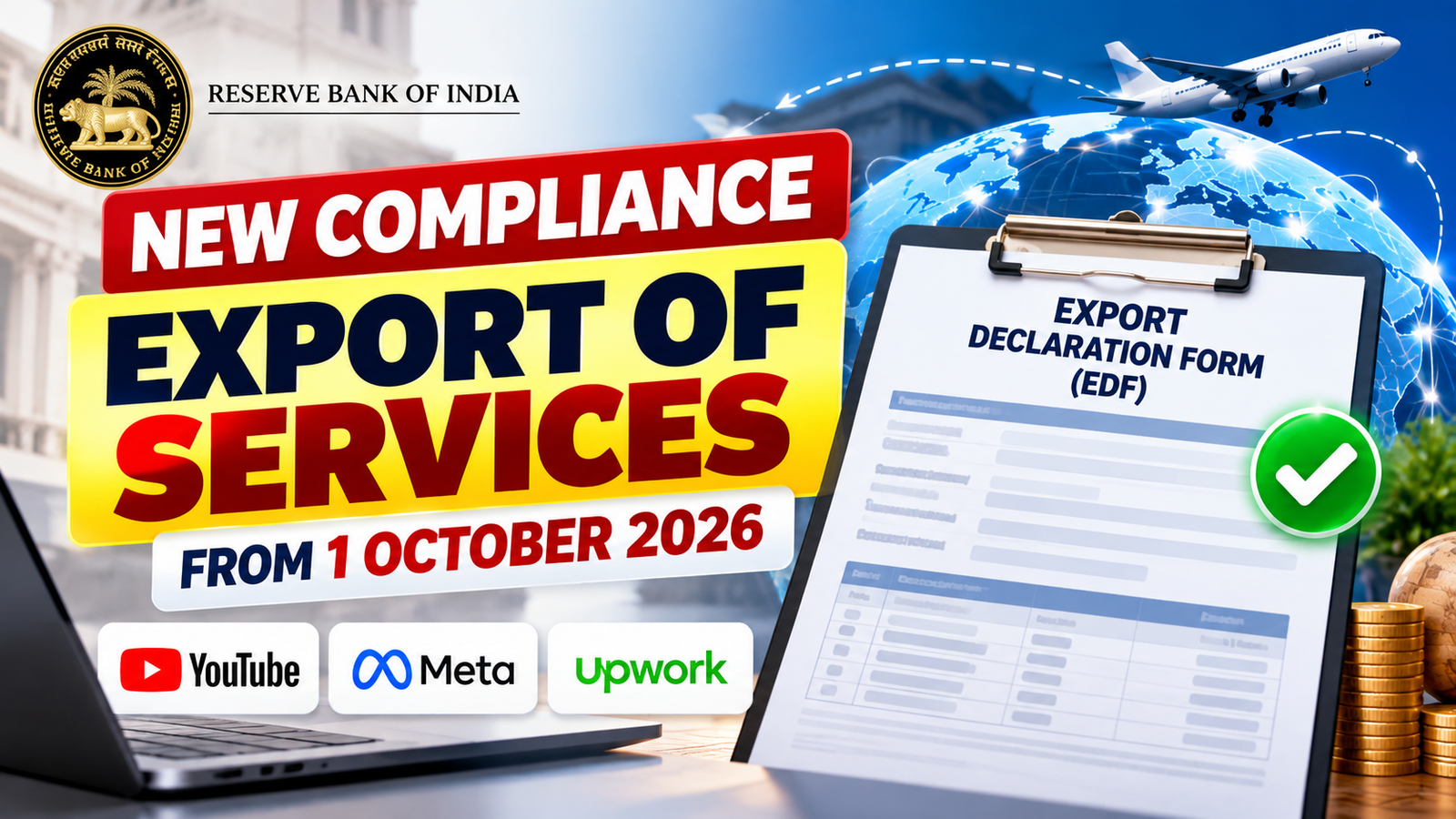
A significant change has taken effect from 1 October 2026 for persons and businesses in India receiving payments from overseas for services.
The Reserve Bank of India’s Foreign Exchange Management (Export and Import of Goods and Services) Regulations, 2026 have replaced the earlier FEMA export framework. These Regulations came into force on 1 October 2026.
One of the important changes is the introduction of a common Export Declaration Form (EDF) framework for exports of goods, services and software.
This is particularly relevant for:
- Freelancers
- Consultants
- Content creators
- YouTubers
- Social-media influencers
- Digital marketers
- Designers
- Agencies
- IT and software service providers
- Other professionals providing services to overseas recipients
For service exporters operating from the Domestic Tariff Area, the Authorised Dealer (AD) bank is the specified authority for services other than software. For software exports, the framework also recognises AD banks/STPI in the DTA, with separate arrangements for SEZs.
1. What has changed from 1 October 2026?
Under the earlier FEMA framework, exports of services for which none of the prescribed declaration forms applied could generally be made without furnishing an export declaration.
The 2026 Regulations change this framework.
Regulation 3(2) now provides that an exporter of services must furnish an Export Declaration Form (EDF) declaring the amount representing the full export value of the services. (eGazette)
Therefore, a person receiving money from an overseas recipient for genuine export of services should examine whether the transaction falls within the new FEMA reporting requirements.
Important point
This is not a new GST form.
EDF is a FEMA/RBI export declaration and is separate from GST returns, GST invoices, LUT and income-tax compliance.
2. Who can be affected by this requirement?
The change can affect a wide range of service exporters.
For example:
Freelancers
If a person in India provides graphic-design, consulting, programming, marketing, writing or other services to a foreign client and receives payment from outside India, the transaction may constitute an export of services.
YouTubers and content creators
A content creator receiving income from an overseas entity may need to examine whether the underlying transaction constitutes export of services and whether EDF reporting applies.
For example, income may arise through arrangements involving:
- YouTube/Google
- Meta
- Upwork
- Fiverr
- Other international platforms or clients
However, the fact that money comes from abroad does not by itself automatically make every receipt an export of service. The underlying contractual arrangement, recipient, nature of service and place-of-supply conditions need to be examined.
3. What is an Export of Service under GST?
This is a very important distinction.
Under Section 2(6) of the IGST Act, a service qualifies as an export of service when the prescribed conditions are satisfied, including:
- The supplier is located in India.
- The recipient is located outside India.
- The place of supply is outside India.
- Payment is received in convertible foreign exchange, subject to the applicable legal framework.
- The supplier and recipient are not merely establishments of the same person.
CBIC has also reproduced these conditions in its official guidance. (CBIC GST)
Therefore, simply saying:
“I received dollars, so it is export.”
would not be sufficient for GST purposes.
The complete transaction needs to satisfy the applicable conditions.
4. Where does the EDF have to be submitted?
For a service exporter in the Domestic Tariff Area (DTA), the specified authority for services other than software is the Authorised Dealer (AD).
An AD is essentially the bank authorised under FEMA to deal in foreign exchange transactions.
Therefore, for a typical freelancer, consultant or content creator receiving overseas service income, the relevant bank through which the export proceeds are handled becomes extremely important.
The exact operational method—online submission, bank portal, email or another bank-specific process—can vary according to the AD bank’s internal procedure.
So it should not be assumed that every bank will necessarily accept EDF through the same method.
5. What is the deadline for filing EDF?
This is one of the most important corrections to the source news.
The uploaded source states that the EDF should be submitted within 30 days from the date of raising the invoice.
That is not the wording of Regulation 3(2).
The 2026 Regulations provide that EDF is to be furnished:
within 30 days from the end of the month in which the invoice for services has been raised.
(eGazette)
Example
Suppose an exporter raises invoices during October 2026.
The normal monthly EDF deadline would be:
30 November 2026
—not 30 days from each individual invoice date.
This distinction is important for monthly compliance planning.
6. Can one EDF cover multiple invoices?
Yes.
This is actually one of the useful features of the new framework.
The Regulations specifically provide that where an exporter has exported services to one or more recipients during a month, a single EDF can be submitted for all such exports. (eGazette)
Therefore, a service exporter does not necessarily need to prepare a completely separate EDF for every invoice.
Example
Suppose a content creator has the following export invoices in October:
| Recipient | Invoice | Amount |
|---|---|---|
| Google/overseas entity | INV-101 | USD 1,000 |
| Meta/overseas entity | INV-102 | USD 700 |
| Foreign client | INV-103 | USD 500 |
Subject to the applicable transaction details and bank process, these services can be covered in one monthly EDF.
The EDF itself contains invoice-level information for the services being reported. (Scribd)
7. Special alternative for services other than software
There is another important provision which was not properly highlighted in the source.
For services other than software, the exporter may submit the EDF on or before the date of receipt of payment. (eGazette)
Therefore, there are effectively two relevant routes:
Normal route
Invoice raised during the month → EDF within 30 days from the end of that month
Alternative route for services other than software
EDF on or before receipt of payment
This provides some flexibility to service exporters.
8. Can the bank extend the EDF filing time?
Yes.
The Regulations permit the Authorised Dealer to extend the period for submission of EDF when the exporter requests an extension and provides reasons for the delay.
The AD must be satisfied regarding the reasonableness of the request. (eGazette)
Therefore, if there is a genuine delay, the exporter should approach the bank rather than simply ignoring the requirement.
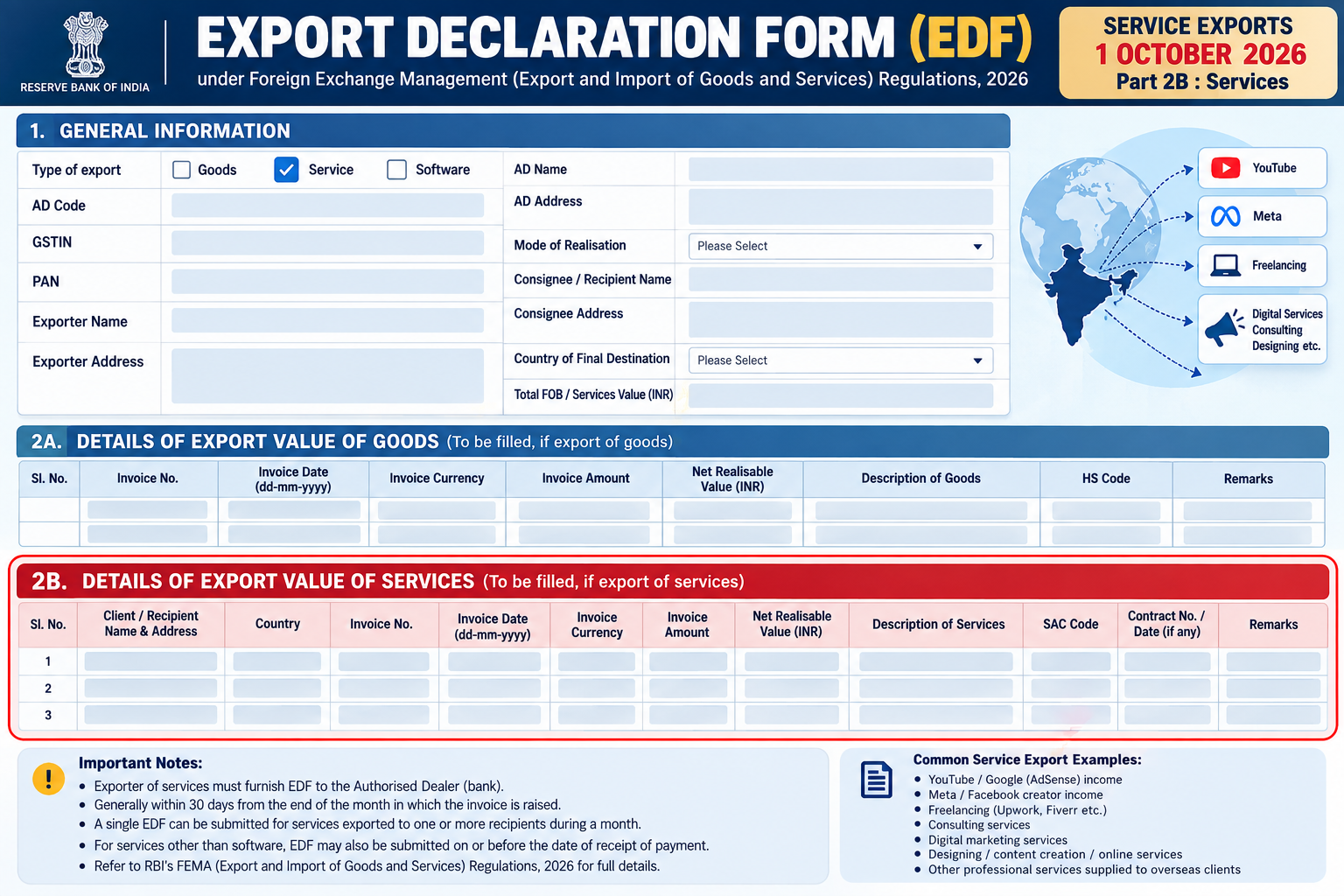
9. What information is required in the EDF?
The prescribed EDF contains substantially more information than simply the amount received.
The form includes general information such as:
- Type of export
- AD code
- IE Code
- GSTIN
- PAN
- Exporter’s name and address
- AD bank details
- Mode of realisation
- Consignee/recipient details
- Third-party payment details, where applicable
- Description of goods/services
- Total export value
For services, the relevant section also captures information such as:
- Recipient name and address
- Country
- Invoice number
- Invoice date
- Currency
- Invoice amount
- Net realisable value
- Contract number/date, where applicable
- Description of services
- SAC code
- Remarks
This means that maintaining proper invoice and payment records becomes particularly important.
10. What should YouTubers and content creators maintain?
A content creator receiving foreign income should ideally maintain a proper record of:
1. Agreement/contract
Keep the agreement or platform terms showing the relevant contracting/recipient entity.
2. Payment statement
Download the payment statement or receipt from the relevant platform.
3. Export invoice
Prepare the corresponding invoice with appropriate details.
4. Bank statement
Maintain the bank credit/remittance record.
5. EDF
Maintain the EDF submitted to the AD bank.
6. GST records
Where registered, maintain the export invoice, LUT and relevant GST return records.
This creates a clear trail:
Contract → Invoice → EDF → Foreign Remittance → Bank Statement → GST Reporting
11. Do not decide the recipient merely from the country from which payment is received
This is another important practical point.
The source material gives an example where the contractual entity may be Google LLC while the actual payment may be routed from another location.
The correct approach is to examine the actual contractual/recipient details and supporting documentation rather than simply using the country from which the money happened to be remitted.
For example, a payment may be routed through a different group entity, payment centre or banking arrangement.
Therefore:
Payment origin ≠ automatically the recipient of service.
The agreement, invoice/payment statement and transaction structure should be examined together.
Export realisation period has also changed
There is another important change from 1 October 2026 that should not be missed.
Under the amended Regulation 5, the export proceeds for services, including software, generally have to be realised and repatriated within:
9 months from the date of invoice
For exports invoiced or settled in Indian Rupees, the applicable period is 12 months, subject to the regulatory conditions.
The September 2026 amendment substituted 9 months for the 15-month period appearing in the January 2026 Regulations before they came into force. The amendment became effective from 1 October 2026.
Therefore, from 1 October 2026:
| Export | Realisation period |
|---|---|
| Services/software | 9 months from invoice |
| Export invoiced/settled in INR | 12 months |
| Goods | Generally 9 months from shipment |
| Goods to overseas warehouse | 9 months from sale from warehouse |
| Project exports | As per contractual payment terms |
The AD bank can also consider an extension where the exporter requests it and provides reasons, subject to the applicable framework.
GST compliance for service exporters
The RBI requirement does not replace GST compliance.
An exporter of services should separately examine GST registration and zero-rated supply requirements.
Exports of services are treated as zero-rated supplies under Section 16 of the IGST Act. A registered person can generally export:
- under LUT/bond without payment of IGST and claim eligible refund of unutilised ITC; or
- on payment of IGST and claim refund, subject to the applicable conditions. (CBIC GST)
GST registration
CBIC’s FAQ specifically states that a person whose outward supplies are entirely export services needs GST registration to claim refunds because exports are zero-rated.
The general threshold for service suppliers is ₹20 lakh, subject to applicable exceptions and the lower threshold applicable in specified special-category States.
LUT is important for zero-rated exports
If a registered exporter wants to export services without payment of IGST, the export is generally made under a Letter of Undertaking (LUT), subject to the applicable GST provisions and conditions. CBIC’s guidance recognises export under LUT without payment of IGST and the corresponding refund mechanism for eligible accumulated ITC. (CBIC GST)
Therefore, a service exporter should keep the following aligned:
GST Registration → LUT → Export Invoice → GST Return → EDF → Bank Realisation
Export invoice should also be prepared correctly
For a registered person making export supplies, the GST invoice rules prescribe the relevant export endorsement.
Depending upon the method adopted, the invoice should carry an endorsement such as:
“SUPPLY MEANT FOR EXPORT UNDER BOND OR LETTER OF UNDERTAKING WITHOUT PAYMENT OF IGST”
or the corresponding endorsement where IGST is paid. The rules also prescribe relevant recipient/country details for export invoices. (CBIC GST)
The invoice should also contain the prescribed invoice particulars, including invoice number, date, supplier details, recipient details, description and applicable service classification.
Keep RBI and GST figures reconciled
This is likely to become increasingly important.
Suppose your October 2026 export invoices show:
₹10 lakh
Your:
- GST export invoices
- GST return
- EDF
- Bank remittance
- Accounting records
should be capable of being reconciled.
The EDF itself contains invoice-level information and SAC details for service exports.
Therefore, maintaining one common export-sales working file can be extremely useful.
Example – YouTube income
Suppose a creator in India receives income from an overseas contracting entity for services/content-related activity.
Step 1 – Identify the recipient
Check the agreement/payment statement and identify the actual overseas recipient.
Step 2 – Raise the export invoice
Prepare the invoice with the appropriate service description and other required details.
Step 3 – GST
Determine whether the transaction qualifies as export of service and whether GST registration/LUT requirements apply.
Step 4 – EDF
Include the transaction in the EDF applicable to the month.
Step 5 – Submit to AD bank
Submit the EDF according to the bank’s prescribed process.
Step 6 – Receive foreign exchange
Ensure the payment is received and appropriately recorded.
Step 7 – Reconcile
Match:
Invoice ↔ EDF ↔ Bank Credit ↔ GST Records
Example – Multiple platforms in one month
Suppose a creator receives income from:
- YouTube
- Meta
- Upwork
- Direct foreign client
during October 2026.
If the underlying transactions qualify as exports of services, the new FEMA framework permits a single EDF covering services exported to one or more recipients during the month. (eGazette)
The EDF would nevertheless contain the relevant invoice/recipient-wise information.
This is more efficient than assuming that a completely separate EDF is necessarily required for every invoice.
What should service exporters do now?
From a practical compliance perspective, service exporters should take the following steps:
✔ Review foreign income
Identify all receipts from overseas entities/clients.
✔ Identify the actual recipient
Do not rely only on the country from which the money is credited.
✔ Check export-of-service conditions
Confirm the GST definition and place-of-supply requirements.
✔ Check GST registration
Review aggregate turnover and the requirement for registration/refund.
✔ Maintain LUT
Where exporting without payment of IGST, ensure the applicable LUT compliance is in place.
✔ Prepare proper invoices
Keep invoice details consistent with GST and FEMA requirements.
✔ Contact the AD bank
Ask the bank about its EDF submission process.
✔ Maintain monthly EDF workings
Even though the filing deadline is linked to the end of the invoice month, maintaining monthly data will make compliance easier.
✔ Reconcile bank and GST records
Ensure the invoice values, EDF values and remittances can be reconciled.
The news about a new FEMA compliance requirement for service exporters from 1 October 2026 is genuine, but it should be explained carefully.
The most important change is that service exports are now brought within the Export Declaration Form (EDF) framework under the Foreign Exchange Management (Export and Import of Goods and Services) Regulations, 2026. For service exporters in the DTA, the relevant specified authority is generally the Authorised Dealer bank.
For freelancers, YouTubers, influencers, consultants and other professionals receiving overseas service income, the practical message is:
Foreign income → identify the actual export transaction → raise proper invoice → complete GST compliance where applicable → report through EDF → receive and reconcile the export proceeds.
Most importantly, the EDF deadline should be remembered correctly:
30 days from the end of the month in which the service invoice is raised — not 30 days from the individual invoice date.
And for services other than software, the Regulations provide an additional option to submit the EDF on or before receipt of payment. (eGazette)
The RBI’s new framework is therefore not merely about a new form; it creates a more structured reporting and monitoring mechanism for cross-border service transactions. Service exporters should coordinate their invoicing, GST, banking and FEMA records so that the same transaction can be properly traced across all four areas.
Visit www.cagurujiclasses.com for practical courses