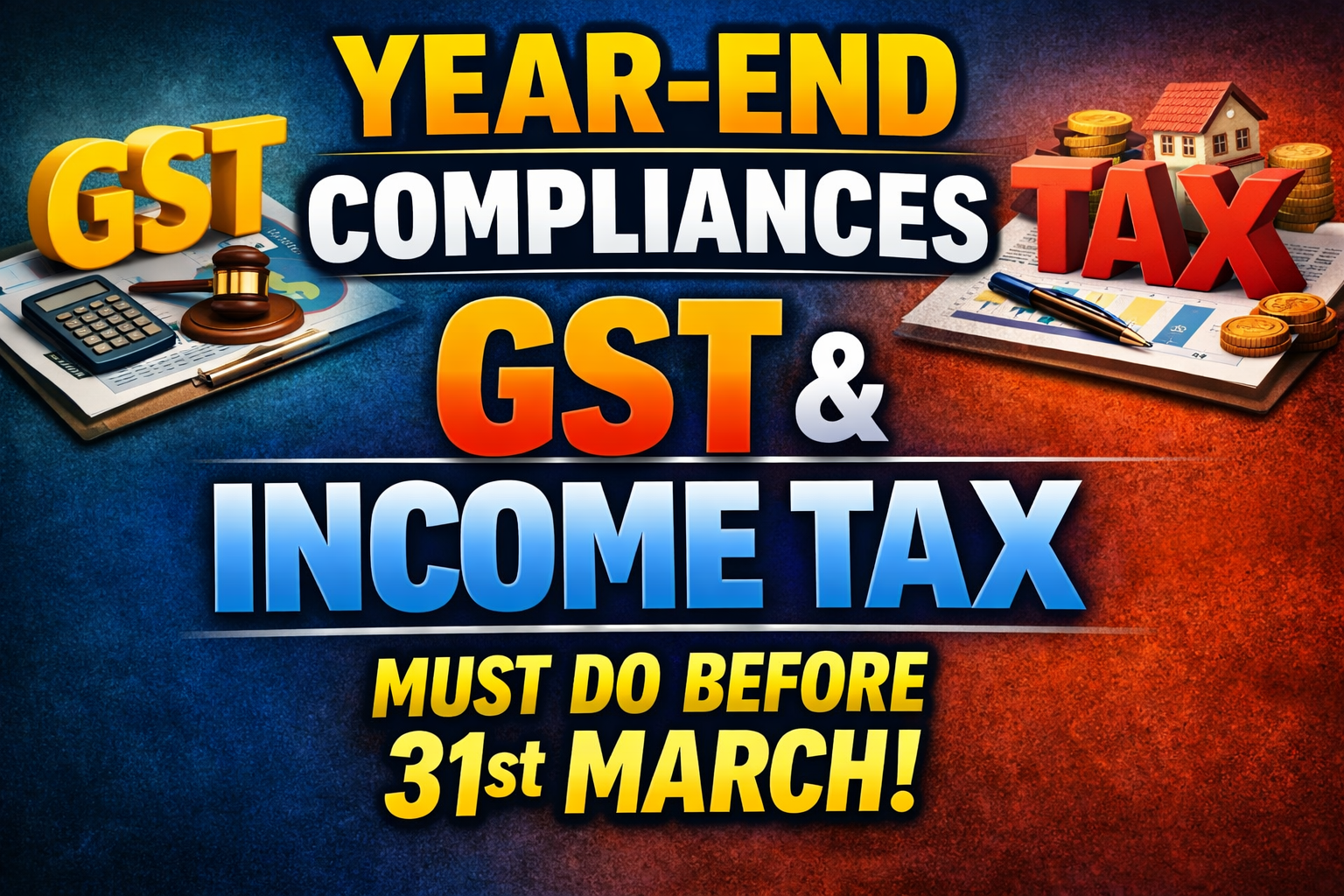
As the financial year 2025-26 is coming to an end, it becomes extremely important for taxpayers, professionals, and businesses to ensure that all GST and income tax compliances are properly completed before 31st March 2026.
Year-end GST and income tax activities are not just about filing returns—they involve turnover analysis, reconciliation, ITC validation, system readiness, and compliance checks to avoid future notices, penalties, and litigation.
In this article, we have covered a complete GST and income taxyear-end compliance checklist, including all important updates effective from 1 April 2026.
📊GST Year-End Compliance Checklist
🔍 1. Importance of Aggregate Turnover (Most Critical Step)
The first and most important activity is to calculate aggregate turnover on PAN basis.
👉 Even if you have multiple GST registrations, turnover must be calculated combined across all registrations under the same PAN.
Why Turnover is Important?
It determines applicability of:
- GST Registration (₹20L / ₹40L limits)
- Composition Scheme (₹1.5 Cr)
- QRMP Scheme (₹5 Cr)
- E-invoicing (₹5 Cr)
- HSN Code Requirement
👉 Incorrect turnover calculation may lead to wrong compliance category, resulting in penalties.
📄 2. LUT Filing for Exporters (Zero-Rated Supply)
For exporters and SEZ suppliers, LUT (Letter of Undertaking) is mandatory if you want to export without payment of IGST.
Key Points:
- LUT must be filed in Form RFD-11
- Applicable for:
- Export of goods/services
- Supply to SEZ
- Deadline: Before 31 March 2026 (for FY 2026-27)
⚠️ If LUT is not filed, department may deny zero-rated benefit (litigation risk).
🔄 3. Composition Scheme – Important Year-End Decision
Option 1: Normal → Composition
If turnover is below ₹1.5 Cr:
- File CMP-02 (before 1 April 2026)
- Reverse ITC via ITC-03 (within 60 days)
Option 2: Composition → Normal
- File CMP-04 (within 7 days)
- Claim ITC via ITC-01 (within 30 days)
👉 This transition requires careful ITC adjustments.
📊 4. QRMP Scheme (Quarterly Filing)
Applicable if turnover ≤ ₹5 Cr
Key Features:
- GSTR-1 & GSTR-3B → Quarterly
- Tax payment → Monthly (PMT-06)
- IFF available for B2B invoices
Deadline to opt:
👉 30 April 2026
🚚 5. GTA (Transporter) – Forward vs Reverse Charge
GTA can choose:
Forward Charge:
- File Annexure V (by 31 March 2026)
- GST @ 5% or 18%
Reverse Charge:
- Default system (recipient pays GST)
👉 Once forward charge is selected → continues for future years
🧾 6. New Invoice Series (Mandatory Practice)
From 1 April 2026, start a new invoice numbering series
Applicable for:
- Tax Invoice
- Debit/Credit Notes
- Bill of Supply
👉 As per Rule 46, invoice number must not exceed 16 characters
⚡ 7. E-Invoicing Requirement
If turnover exceeds ₹5 Cr in any previous year:
👉 E-invoicing becomes mandatory
Applicable for:
- B2B supplies
- Export
- SEZ
Not applicable for:
- Banks, NBFCs
- GTA
- Passenger transport
- Government entities
⚠️ Without IRN → Buyer cannot claim ITC
🏷️ 8. HSN Code Compliance
| Turnover | Requirement |
|---|---|
| < ₹5 Cr | 4-digit (B2B) |
| > ₹5 Cr | 6-digit mandatory |
| Export | 8-digit |
👉 Ensure HSN in invoice = HSN in GSTR-1 (Table 12)
🔧 9. Job Work Compliance (ITC-04)
- Inputs must return within 1 year
- Capital goods within 3 years
Filing:
- ₹5 Cr → Half-yearly
- ≤ ₹5 Cr → Annual
⚠️ Delay = Deemed Supply
🔄 10. GST 2.0 Changes (Rate Rationalisation)
From 22 Sept 2025:
- Old slabs → replaced with:
- 5%
- 18%
- 40%
Action Required:
- Update ERP / billing system
- Verify HSN mapping
- Check rate applied correctly
💰 11. Credit Note & Discount Changes
Major relief:
Earlier conditions:
- Agreement required
- Invoice linkage required
Now:
👉 Only condition: Recipient must reverse ITC
📦 12. Outward Supply Reconciliation
Match:
- Books
- E-way bill
- GST returns
- E-invoice (if applicable)
Common Issues:
- Missing invoices
- Wrong tax rate
- Unreported sales
⚠️ Mismatch → Notices under Section 61
📥 13. ITC Reconciliation (Most Important)
Match:
- Books vs GSTR-2B vs GSTR-3B
Key Checks:
- ITC not claimed
- Wrong ITC claimed
- Vendor non-compliance
👉 Last date to correct ITC (FY 25-26):
30 November 2026
🔁 14. ITC Reversal Rules
Rule 37:
- Non-payment within 180 days → ITC reversal
Rule 37A:
- Supplier not paid tax → reverse ITC
Section 17(5):
- Blocked credits (food, motor vehicles etc.)
⚠️ 15. Rule 88C & 88D (Notices)
- 88C → GSTR-1 vs 3B mismatch
- 88D → ITC mismatch with 2B
👉 Reply within 7 days
🏢 16. ISD (Input Service Distributor)
From April 2025 → Mandatory
- Distribute common service ITC
- Based on turnover
🧾 17. IMS (Invoice Management System)
From Oct 2025:
- Accept / Reject / Pending invoices
- No action = deemed accepted
📊 18. Stock & Inventory Check
- Physical vs Book stock
- Damaged goods → ITC reversal
- Goods in transit → ITC not allowed
⚖️ 19. Litigation & Notices
- Check GST portal regularly
- Respond to ASMT-10, DRC notices
- Appeal deadline tracking
🏦 20. Other Important Checks
- Bank details updated
- Authorized signatory updated
- Aadhaar authentication done
Here is a professional, complete checklist of Income Tax compliances to be completed before 31 March 2026 (very useful for your video/blog content):
📊 Income Tax Year-End Compliance Checklist
(Deadline: 31 March 2026)
This date is extremely critical because many provisions become time-barred after 31 March 2026.
🚨 1. Updated ITR Filing (Most Important)
📌 Applicable Section: 139(8A)
👉 You can file Updated Return (ITR-U) for:
- FY 2020-21 (AY 2021-22) → Last date: 31 March 2026
⚠️ After this date:
- Return cannot be filed
- Income becomes permanently non-compliant
- Risk of notice increases
📑 2. TDS / TCS Correction Statements (Very Critical)
As per new Income Tax Act, 2025 – Section 397(3)(f):
👉 Correction statements allowed only till 31 March 2026 for:
- FY 2018-19 → Q4
- FY 2019-20 → Q1 to Q4
- FY 2020-21 → Q1 to Q4
- FY 2021-22 → Q1 to Q4
- FY 2022-23 → Q1 to Q4
- FY 2023-24 → Q1 to Q3
⚠️ After 31 March 2026:
❌ No correction allowed
❌ Errors remain permanently
❌ Demand / penalty risk
👉 Very important for:
- Wrong PAN
- Short deduction
- Late filing corrections
💰 3. Advance Tax / Self-Assessment Planning
Before 31 March:
- Review total income
- Adjust:
- Advance tax paid
- TDS/TCS
- Pay remaining tax (if any)
👉 Helps avoid:
- Interest u/s 234B / 234C
📊 4. Capital Gain Planning
Before 31 March 2026:
- Invest in:
- Capital Gain Bonds (54EC)
- House property (54 / 54F)
- Plan set-off of losses
👉 Otherwise:
- Higher tax liability
📉 5. Loss Booking (Tax Planning)
👉 Review:
- Capital loss
- Business loss
If needed:
- Book losses before 31 March
👉 So that:
- Can be set-off in future
🧾 6. Section 80 Deductions (Final Chance)
Before 31 March:
Ensure investments/payments done for:
- 80C (LIC, PPF, ELSS etc.)
- 80D (Medical insurance)
- 80G (Donations)
- 80CCD(1B) (NPS)
👉 After 31 March → No benefit for FY 2025-26
🏢 7. Books of Accounts Finalisation
- Close books properly
- Verify:
- Income
- Expenses
- Provisions
👉 Important for:
- Correct ITR filing
- Avoid mismatch with AIS / 26AS
🔍 8. AIS / 26AS Reconciliation
👉 Must check:
- Interest income
- TDS entries
- High-value transactions
⚠️ If mismatch not corrected:
- Notice risk increases
💼 9. MSME Payment Compliance (Important)
As per Income Tax provisions:
👉 If payment to MSME not made within:
- 15 / 45 days
Then:
❌ Expense disallowed
👉 So:
- Clear dues before 31 March
🧾 10. TDS Deduction & Payment
- Ensure all TDS deducted
- Deposit before due dates
👉 Otherwise:
- Interest
- Disallowance of expense
📊 11. PAN-Aadhaar Linking (If Pending)
👉 Check if any pending cases
⚠️ If not linked:
- PAN becomes inoperative
- TDS @ higher rate
🏦 12. Specified Transactions Compliance
Ensure PAN is quoted correctly in:
- Property transactions
- Bank deposits
- High-value purchases
⚠️ 13. Clean-up of Old Defaults
Before 31 March:
- Clear pending demands
- Respond to notices
- Correct old errors
👉 Because:
- Many items become time-barred after this date
🚀 14. Business Owners – Special Checklist
- Stock valuation
- Expense booking
- Income recognition
- GST vs Income Tax reconciliation
Visit www.cagurujiclasses.com for practical courses