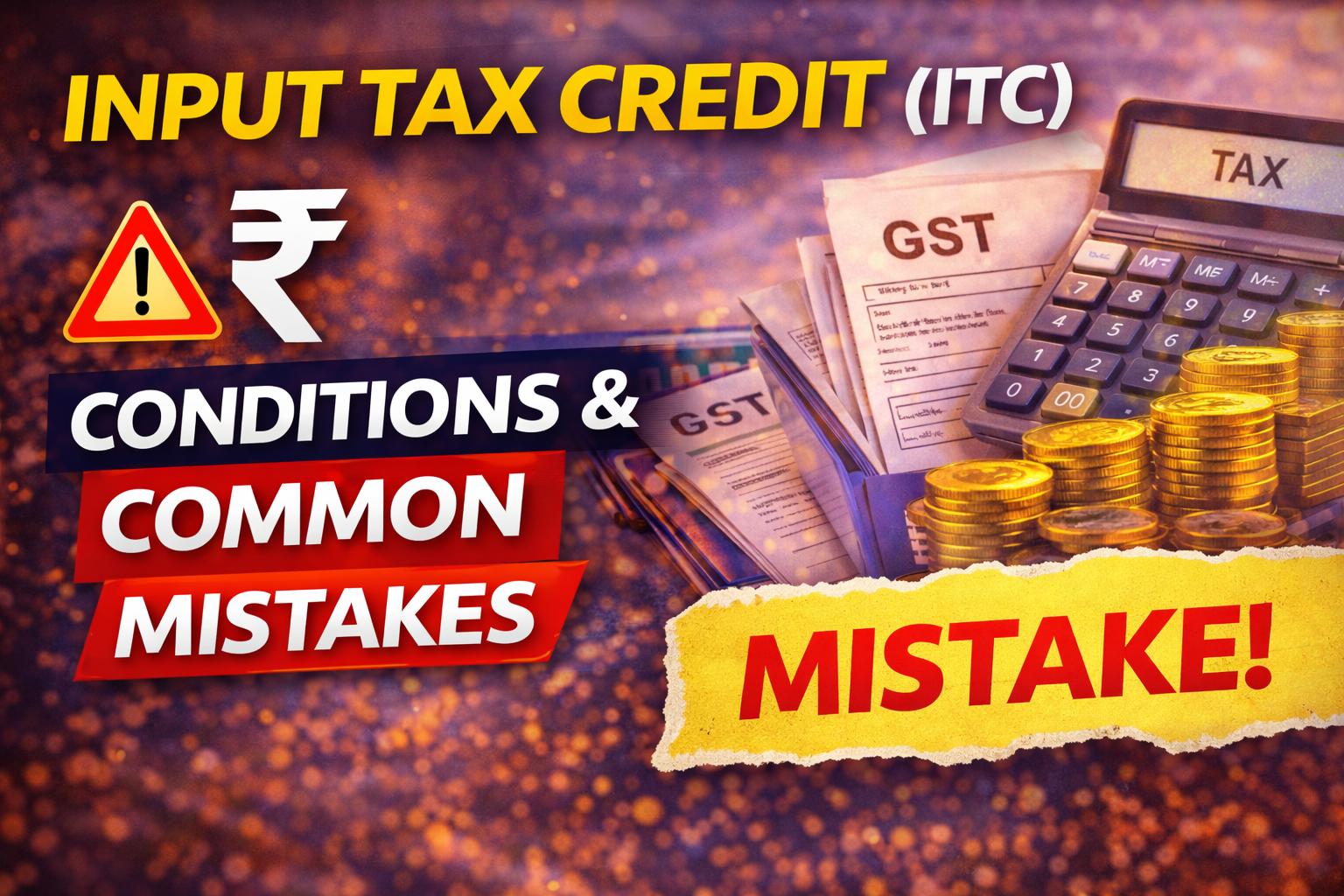
Input Tax Credit (ITC) is one of the most important features of the GST system in India. It allows businesses to reduce their GST liability by claiming credit for GST paid on purchases used in business activities. The objective of ITC is to eliminate the cascading effect of taxes (tax on tax) and ensure that GST is charged only on the value addition at each stage of the supply chain.
However, ITC is not automatic. A taxpayer must satisfy specific conditions prescribed under Section 16 of the CGST Act and follow proper compliance procedures. Failure to comply with these conditions can lead to ITC reversal, interest, penalties, and GST notices.
This article explains the conditions for claiming ITC and the common mistakes taxpayers should avoid.
What is Input Tax Credit (ITC)?
Input Tax Credit refers to the GST paid on purchases of goods or services used for business purposes, which can be deducted from the GST payable on sales.
Example
Suppose a manufacturer purchases raw materials worth ₹4,00,000 and pays ₹72,000 GST.
Later, the finished goods are sold for ₹10,00,000, and GST charged is ₹1,80,000.
Net GST payable = ₹1,80,000 – ₹72,000
GST payable = ₹1,08,000
Thus, ITC reduces the tax burden on businesses.
Legal Provision for ITC under GST
The eligibility and conditions for claiming Input Tax Credit are provided under Section 16 of the CGST Act, 2017. This section states that a registered person is entitled to claim ITC on goods or services used in the course of business, subject to prescribed conditions.
Conditions to Claim Input Tax Credit
To claim ITC under GST, a taxpayer must satisfy the following key conditions:
1. Possession of a Valid Tax Invoice
The taxpayer must possess a valid tax invoice, debit note, or other prescribed document issued by a registered supplier.
The invoice must contain:
- Supplier GSTIN
- Invoice number and date
- Description of goods/services
- Tax amount and rate
Without proper documentation, ITC cannot be claimed.
2. Receipt of Goods or Services
ITC can be claimed only after the goods or services have actually been received.
For example:
- If goods are purchased but not delivered, ITC cannot be claimed.
- If services are not provided, ITC cannot be availed.
This rule prevents fake ITC claims.
3. Supplier Must Pay GST to Government
ITC can be claimed only if the supplier has deposited GST with the government and reported the invoice in their GST return.
In practice, the invoice should appear in GSTR-2B of the recipient.
4. Filing of GST Returns
The taxpayer must file GST returns (GSTR-3B) in order to claim ITC.
If returns are not filed, ITC cannot be utilized.
5. Payment to Supplier within 180 Days
The buyer must pay the supplier invoice value plus GST within 180 days.
If payment is not made within this period:
- ITC must be reversed
- Interest may apply
Once payment is made, the ITC can be reclaimed.
6. ITC Must Be Used for Business Purposes
ITC is allowed only on goods or services used in the course or furtherance of business.
ITC is not allowed for personal use.
7. Time Limit to Claim ITC
ITC must be claimed before the earlier of the following:
- Filing of annual return
- 30 November of the next financial year
After this deadline, ITC cannot be claimed.
Blocked Credits – Cases Where ITC is Not Allowed
GST law also specifies certain blocked credits where ITC cannot be claimed.
Examples include:
- Motor vehicles for personal transport
- Personal consumption expenses
- Food and beverages for employees
- Membership of clubs or gyms
- Goods given as gifts or free samples
For example, ITC is generally not available on motor vehicles used to transport persons with seating capacity up to 13 (with certain exceptions).
Common ITC Mistakes Made by Businesses
Many businesses face GST notices due to mistakes while claiming ITC. Below are some common errors:
1. Incorrect Invoice Details
One of the most common reasons for ITC rejection is incorrect or incomplete invoice data, such as:
- Wrong GSTIN
- Incorrect tax amount
- Missing invoice number
Even small errors can cause ITC mismatch.
2. ITC Claimed Without GSTR-2B Matching
Taxpayers sometimes claim ITC even when the invoice does not appear in GSTR-2B.
This may happen if the supplier:
- Has not filed GSTR-1
- Has filed incorrect details
3. Claiming ITC on Ineligible Expenses
Many businesses mistakenly claim ITC on blocked credits, such as:
- Motor cars
- Personal expenses
- employee welfare expenses
Such claims may lead to ITC reversal.
4. Not Reconciling ITC with Purchase Register
Failure to perform regular ITC reconciliation between:
- purchase register
- GSTR-2B
- GSTR-3B
can result in excess ITC claims.
5. Late Filing of GST Returns
Delayed GST returns can cause loss of ITC or penalties.
Regular and timely filing helps avoid compliance issues.
6. Claiming Fake or Bogus ITC
In some cases, businesses intentionally claim ITC using fake invoices without actual supply of goods.
Authorities have detected several large frauds involving fake ITC claims through bogus invoices and non-existent firms.
Such actions may lead to:
- heavy penalties
- GST registration cancellation
- prosecution.
Penalties for Wrong ITC Claims
Incorrect ITC claims can lead to:
- Interest @18% on excess ITC claimed
- Penalty up to ₹10,000 or tax amount
- Possible suspension or cancellation of GST registration.
Therefore, businesses should carefully verify eligibility before claiming ITC.
Best Practices to Avoid ITC Issues
To ensure smooth ITC compliance, businesses should:
✔ Reconcile purchase register with GSTR-2B every month
✔ Verify supplier GST compliance
✔ Check invoice details carefully
✔ File GST returns on time
✔ Maintain proper documentation
Automation tools and proper accounting systems can also reduce ITC errors.
Input Tax Credit is a major benefit under the GST system as it helps businesses reduce tax liability and improve cash flow. However, ITC can be claimed only if the conditions specified under Section 16 of the CGST Act are satisfied.
Businesses must ensure proper documentation, supplier compliance, timely return filing, and regular reconciliation to avoid ITC reversals and penalties. Understanding the rules, restrictions, and common mistakes related to ITC is essential for maintaining GST compliance and avoiding costly tax disputes.
Disclaimer
The contents of this article are for general informational purposes only and are intended to provide quick access to tax rate information. Readers are advised to verify the provisions with the Income-tax Act, relevant rules, notifications, and official government sources before making financial decisions.
Visit www.cagurujiclasses.com for practical courses