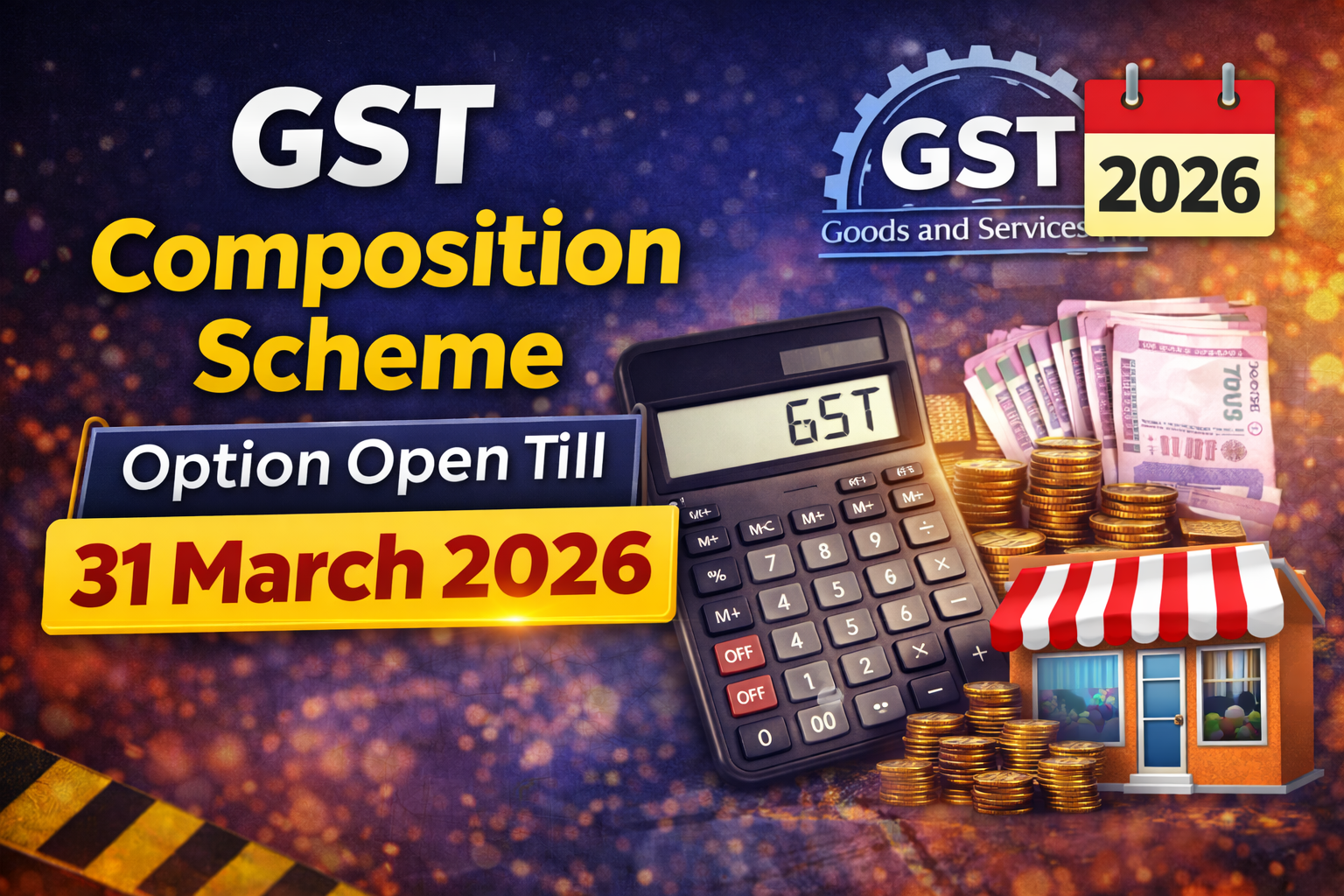
The Goods and Services Tax (GST) portal has opened the option for eligible registered taxpayers to opt for the GST Composition Scheme for the financial year 2026-27. Businesses currently registered under the regular GST scheme can shift to the composition scheme by filing Form GST CMP-02 on the GST portal. The last date to exercise this option is 31 March 2026, and if opted successfully, the scheme will apply from 1 April 2026.
This update is particularly important for small businesses looking to reduce GST compliance burden and simplify tax payments.
What is the GST Composition Scheme?
The GST Composition Scheme is a simplified taxation scheme designed mainly for small taxpayers with lower turnover (AATO upto 1.5 Crore). Under this scheme, businesses pay GST at a fixed percentage of their turnover instead of normal GST rates and enjoy reduced compliance requirements.
The objective of this scheme is to make GST compliance easier for small traders, manufacturers, and service providers by reducing paperwork and return filing requirements.
Last Date to Opt for Composition Scheme
Eligible taxpayers who want to switch from the regular GST scheme to the composition scheme for FY 2026-27 must file Form GST CMP-02 on the GST portal.
Important timeline
- Scheme applicable for: Financial Year 2026-27
- Last date to opt: 31 March 2026
- Effective date of scheme: 1 April 2026
Taxpayers are advised to file the form early to avoid last-minute portal issues and ensure smooth transition to the scheme.
Eligibility for GST Composition Scheme
A taxpayer can opt for the composition scheme if the following conditions are satisfied:
1. Turnover Limit
- Aggregate turnover must not exceed ₹1.5 crore in the preceding financial year.
- For special category states such as North-Eastern states and Himachal Pradesh, the limit is ₹75 lakh.
2. Type of Business
The scheme is available for:
- Manufacturers
- Traders
- Restaurants (not serving alcohol)
- Certain small service providers
GST Rates under Composition Scheme
The tax rates under the scheme are lower than regular GST rates.
| Type of Business | GST Rate |
|---|---|
| Manufacturers and traders | 1% of turnover |
| Restaurants (not serving alcohol) | 5% of turnover |
| Other eligible service providers | 6% of turnover |
These rates are calculated on turnover rather than individual transactions, making tax calculation simpler.
Key Benefits of Composition Scheme
1. Lower Tax Rates
Businesses pay GST at reduced rates compared to the regular scheme.
2. Simplified Compliance
Composition taxpayers have fewer compliance requirements and reduced record-keeping obligations.
3. Fewer Returns
Instead of monthly returns, composition dealers mainly file:
- CMP-08 (quarterly statement)
- GSTR-4 (annual return)
4. Predictable Tax Liability
Tax is calculated as a percentage of turnover, making tax planning easier.
Restrictions under Composition Scheme
Although the scheme offers simplified compliance, it also comes with certain limitations:
- No Input Tax Credit (ITC) can be claimed.
- Taxpayer cannot collect GST from customers.
- Inter-state supply of goods is not allowed.
- Sales through e-commerce operators liable for TCS are restricted.
- Certain manufacturers (e.g., ice-cream, pan masala, tobacco) are not eligible.
Because of these restrictions, the scheme may not be suitable for every business model.
ITC Reversal When Switching to Composition
If a taxpayer shifts from the regular scheme to the composition scheme, Input Tax Credit already claimed must be reversed on:
- Inputs
- Work-in-progress
- Finished goods
- Capital goods (after reduction)
This reversal is done through Form GST ITC-03, generally within the prescribed time after switching schemes.
How to Opt for Composition Scheme on GST Portal
Eligible taxpayers can opt for the scheme through the GST portal by following these steps:
- Log in to the GST Portal
- Go to Services
- Select Registration
- Click Application to Opt for Composition Levy
- File Form GST CMP-02
After successful filing, the taxpayer will be treated as a composition taxpayer from 1 April 2026.
Important Points for Taxpayers
Before opting for the scheme, businesses should carefully evaluate:
- Whether their customers require ITC
- Whether they make inter-state supplies
- Whether their profit margins allow payment of tax from their own pocket
The composition scheme is generally more suitable for small local businesses dealing with end consumers rather than businesses supplying to registered companies.
The GST portal has opened the option for regular taxpayers to switch to the Composition Scheme for FY 2026-27, with 31 March 2026 as the last date to file Form CMP-02. This scheme offers simplified compliance, lower tax rates, and reduced paperwork, making it beneficial for small businesses. However, taxpayers must carefully assess the restrictions such as no ITC and limited supply options before opting for the scheme.
Eligible taxpayers planning to move to the composition scheme should complete the application before the deadline to ensure the benefit is available from 1 April 2026.
Disclaimer
The contents of this article are for general informational purposes only and are intended to provide quick access to tax rate information. Readers are advised to verify the provisions with the Income-tax Act, relevant rules, notifications, and official government sources before making financial decisions.
Visit www.cagurujiclasses.com for practical courses